Fruit Tart (Tarte aux Fruits)
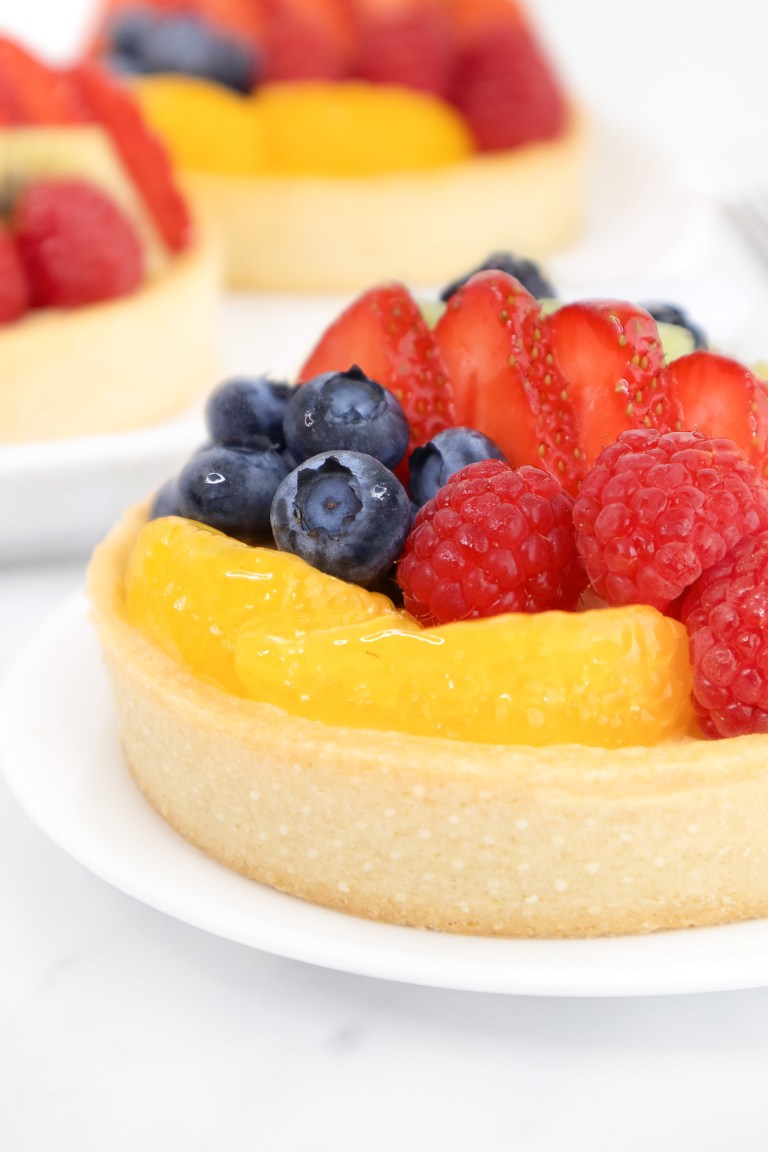
Classic French fruit tarts are a show-stopping dessert, and the perfect way to use fresh spring and summer fruit. Though maybe slightly more challenging than the typical fruit pie or shortcake, French fruit tarts are so delicious and incredibly rewarding to make — not to mention, this recipe covers so many techniques you can use in all of your baking.
Ingredients
Tart Crust (Pâte Sucrée)
- 1 ½ cups all-purpose flour (spooned and leveled)
- ¼ cup super-fine almond flour
- ½ tsp kosher salt (I use Diamond Crystal)
- ½ cup powdered (icing) sugar
- ½ cup (1 stick) unsalted butter, chilled and cut into ¼" cubes
- 1 large egg yolk
- 2 Tbsp cold water
- ½ tsp pure vanilla extract
- ¼ tsp pure almond extract
Pastry Cream (Crème Pâtissière)
- 2 cups whole milk
- ¼ tsp kosher salt
- ½ cup granulated sugar
- ¼ cup cornstarch
- 5 large egg yolks, at room temperature
- ¼ cup (½ stick) unsalted butter
- 1 ½ tsp pure vanilla extract
Apricot Glaze (recipe also here)
- ½ cup good-quality apricot jam (I like St. Dalfour Apricot Jam)
- 1–2 Tbsp granulated sugar
- 1 Tbsp cognac (optional)
Instructions
Preparing the Tart Crust (Pâte Sucrée)
- In the bowl of a stand mixer, whisk together all-purpose flour, almond flour, salt, and powdered sugar. Set the entire bowl in the freezer for 5 minutes to chill.1 ½ cups all-purpose flour¼ cup super-fine almond flour½ tsp kosher salt½ cup powdered (icing) sugar
- After 5 minutes, add in the very cold, cubed butter. Mix on low (I use the #3 speed on my mixer) until the flour/butter mixture becomes the texture of fine cornmeal or almond meal (about 10–12 minutes).½ cup (1 stick) unsalted butter, chilled and cut into ¼" cubes
- In the meantime, in a small bowl, whisk together egg yolk, cold water, vanilla extract, and almond extract until combined. Set liquid mixture in the refrigerator to chill (while waiting for flour and butter to mix).1 large egg yolk2 Tbsp cold water½ tsp pure vanilla extract¼ tsp pure almond extract
- When the flour/butter mixture is ready, with the mixer still on low speed, slowly drizzle in the liquid mixture. Continue to mix just until the dough comes together and no dry spots remain.
- Pick the dough up with your hands and form it into a smooth ball. (You can knead the dough 2 to 3 times, if necessary, but try not to overwork the dough.)For one large 9" tart: Form the dough into a flat disk.For four small 4" tarts: Form the dough into a rectangular shape (to make it easier to cut into four).
- Wrap the dough in plastic wrap and chill in the refrigerator for 1 hour.
- Remove the dough from the refrigerator and allow it to sit at room temperature for 5 to 10 minutes. (You want the dough to warm up just enough to be pliable so that it doesn’t crack when rolling it out.)
- For one large 9" tart: Follow steps 9 to 17 to form and bake the tart, then skip to step 29 to prepare the pastry cream.For four small 4" tarts: Skip to step 18.
Forming & Baking One 9" Tart (Using a Tart Pan)
- On a lightly floured piece of parchment paper, roll the dough out into a circle that is about ⅛" thick. (I recommend using a rolling pin that has adjustable stoppers to help ensure the dough is an even thickness.)
- Carefully flip the parchment paper over onto the tart pan and peel back the parchment paper from the dough.
- Allow the dough to fall into the tart pan, gently pressing it into the bottom edges and sides of the pan, being careful not to stretch the dough. Using your thumb, press the dough firmly into the sides of the pan, making sure it is uniform in thickness all the way around.
- Using your rolling pin, roll the pin over the top edges of your tart pan to trim off any excess dough. Set the tart pan in the freezer for 30 minutes to allow the dough to chill and firm up.
- Meanwhile, preheat oven to 350℉.
- Remove the tart pan from the freezer and set it on a baking sheet. Press a piece of aluminum foil into the bottom edges and sides of the dough, and fill the foil with pie weights, dried beans, or rice.
- Set the tart pan into the center of the oven and blind bake it for 20 minutes.
- Remove the foil and pie weights, prick the bottom of the tart with the tines of a fork, and place it back into the oven until it turns nice and golden brown (about 10–15 minutes, depending on the size of the pan and thickness of the dough).
- Remove from the oven and place the tart crust (still in the tart pan) on a wire rack. Allow the crust to cool completely.
Forming & Baking Four 4" Small Tarts (Using Perforated Tart Rings)
- I recommend cutting the dough in half and working with half of the dough at a time while the other half is set in the refrigerator to chill. Continue alternating between the two halves of the dough while rolling it out and cutting out the tarts.
- On a lightly floured piece of parchment paper, roll out half the dough out into a rectangle that is about ⅛" thick. (I recommend using a rolling pin that has adjustable stoppers to help ensure the dough is an even thickness.)
- Set the dough (still on the parchment paper) on a cutting board or baking sheet and return to the refrigerator for about 10 minutes to chill and firm up slightly. In the meantime, repeat the previous step with the second half of the dough onto a new lightly floured piece of parchment paper.
- Using a perforated tart ring, cut circles into the dough for the bottom of each tart shell (as you would a cookie cutter), but do not remove the tart ring from the dough. The dough should be firm enough that it sticks to the inside of the tart ring; if it doesn't, gently press the dough into the inner edge of the tart ring. Set the tart rings (with the dough) on a plate with parchment paper and into the freezer while working with the other half.Pro tip: If at any time you need to start over, form the dough back into a ball, re-roll it out again onto parchment paper, and set it back in the refrigerator or freezer to chill for a few minutes before moving on.
- Using a knife, cut out strips (about 1" wide) for the sides of each tart shell. The dough should be chilled and firm enough to work with, but not so cold that it cracks.
- Place the strips around the inner edge of each tart ring. Using your fingers, firmly press the strips into the sides of each tart ring and into the bottom of the tart shell so that the bottom and sides fuse together. (You can use multiple strips for each tart shell, just be sure to firmly press any edges together.)
- Using a paring knife, trim the sides of each tart shell so that the sides are flush with the top of each tart ring. (If the dough has gotten too warm and isn't cutting cleanly, set the whole tart shell into the freezer to chill for a few minutes before trimming the sides.)
- Set the tart shells (still on the plate with parchment paper) into the freezer to chill for 30 minutes.
- Meanwhile, preheat oven to 350℉.
- Set the tart shells on a baking sheet lined with a perforated baking mat or a new piece of parchment paper. Bake in the center of the oven until the shells turn nice and golden brown (about 15–20 minutes, depending on the size of the tart rings and thickness of the dough). The tart shell should shrink slightly, pulling away from the sides of the tart ring.
- Remove the tart shells from the oven and allow them to cool completely on the baking sheet.
Preparing the Pastry Cream (Crème Pâtissière)
- In a large bowl, whisk together sugar and cornstarch. (This helps prevent the cornstarch from forming lumps.)½ cup granulated sugar¼ cup cornstarch
- Add in the egg yolks and continue whisking until the mixture is pale yellow in color and forms a slowly dissolving ribbon on the surface when the whisk is lifted from the mixture.5 large egg yolks, at room temperature
- In a heavy-bottomed saucepan, combine milk and salt. Over low heat, gently heat the milk just until it begins to bubble.2 cups whole milk¼ tsp kosher salt
- Whisking constantly, slowly pour the hot milk into the egg yolk mixture — starting with just small dribbles and continuing with a small, but steady, stream — until all of the milk is incorporated.Pro tip: I recommend setting the large bowl (with the egg yolk mixture) on a kitchen towel so the bowl won’t slide around while you are whisking in the hot milk.
- Pour the mixture back into the saucepan and return it to medium heat. Whisk constantly until the mixture becomes thick and begins to bubble, and then for another 1 to 2 minutes more. (The mixture must be heated enough to activate the cornstarch; otherwise, the pastry cream will be runny when it cools.)
- Remove the mixture from heat and whisk in butter and vanilla. Continue whisking until the butter is fully incorporated.¼ cup (½ stick) unsalted butter1 ½ tsp pure vanilla extract
- Press the hot pastry cream through a sieve and into a clean bowl. To prevent a skin from forming on the surface of the pastry cream, press plastic wrap directly onto the surface. Allow to cool until still warm, but not hot (about 30 minutes).
- While the pastry cream is still warm, whisk vigorously until smooth. Spoon the pastry cream into your tart crust. Once again, to prevent a skin from forming, press plastic wrap directly onto the surface of the tart(s). Set the tart(s) in the refrigerator to set and cool completely.
Preparing the Apricot Glaze
- In a small saucepan (or a microwave-safe bowl), heat apricot jam so it can easily be pressed through a sieve.½ cup good-quality apricot jam
- Press apricot jam through a sieve to remove any larger pieces of apricot.
- In a saucepan, mix sieved apricot jam, sugar, and cognac.1–2 Tbsp granulated sugar1 Tbsp cognac (optional)
- Cook over moderate heat for 3 to 5 minutes, until thickened and sticky.
- Turn off heat, but keep the apricot glaze on the hot stove to keep it warm while you assemble your tart.Pro tip: The apricot glaze must be warm enough to remain loose and spreadable with a pastry brush. If it cools and becomes too thick to work with, slowly reheat it and, if necessary, add in a splash of water.
Assembling the Tart(s)
- Once the pastry cream has fully cooled and set in the tart shell, remove the plastic wrap and cover the surface with your favorite fruit.
- Spread the warm apricot glaze over the top of the fruit. (This prevents the fruit from drying out and gives the final tart a nice, professional look.)
- Serve immediately, or refrigerate for up to 3 days. Ideally, the tart(s) should be served within 24 hours to preserve freshness.
Nutrition
Calories: 3810kcal | Carbohydrates: 453g | Protein: 60g | Fat: 197g | Saturated Fat: 108g | Polyunsaturated Fat: 11g | Monounsaturated Fat: 51g | Trans Fat: 6g | Cholesterol: 1526mg | Sodium: 2056mg | Potassium: 1191mg | Fiber: 9g | Sugar: 248g | Vitamin A: 6762IU | Vitamin C: 10mg | Calcium: 888mg | Iron: 13mg