Paella is a rice dish that originated in Valencia, Spain. While the cooking method is largely the same, the exact combination of ingredients varies by region, tradition, and who you ask. In fact, what belongs in a “true” paella is a topic that’s been debated for generations.
Paella Valenciana is the original version, typically made with chicken, rabbit, beans, saffron, paprika, and olive oil. It’s a land-based paella and what many would consider to be the most traditional.
Seafood paella (Paella de Marisco) is a popular variation in coastal regions and replaces the meat with seafood such as shrimp, mussels, clams, and squid.
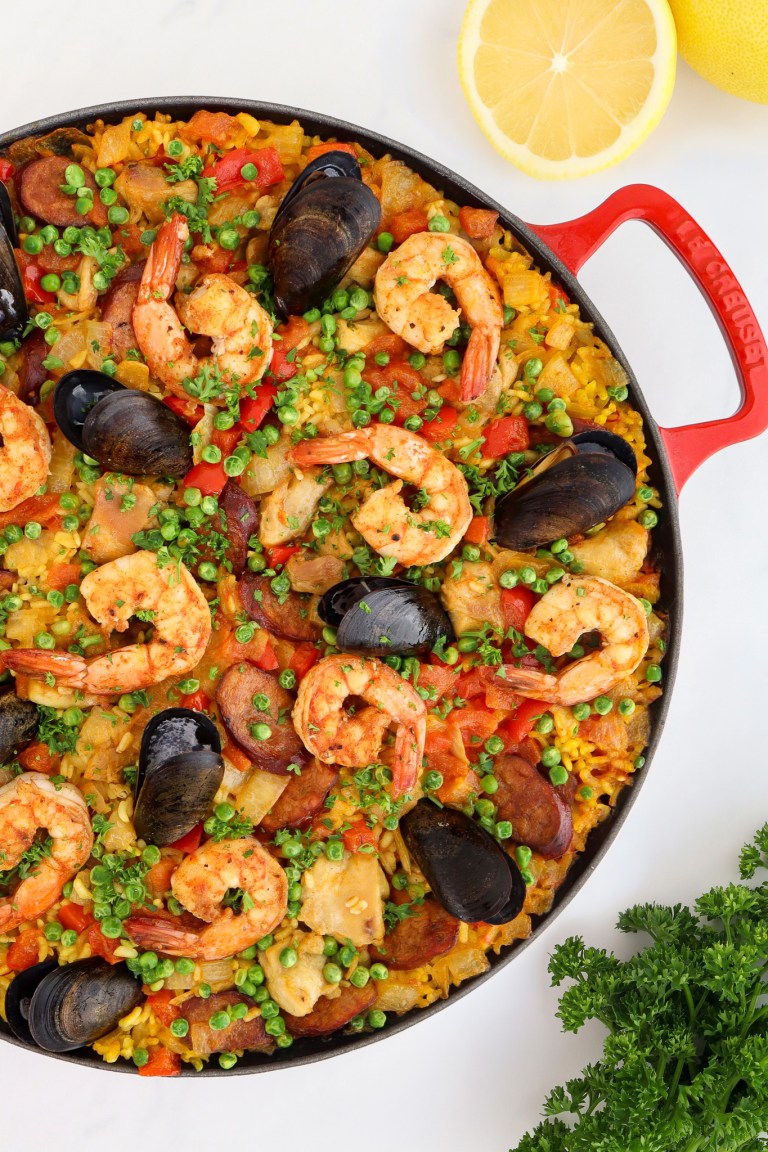
Mixed paella (Paella Mixta) combines both land and sea ingredients, such as chicken, seafood, and vegetables like peppers and peas. Many modern versions also include chorizo for extra flavor, though it isn’t considered traditional in Valencia.
This recipe covers the basics of a mixed paella and reflects the style you’ll often find in restaurants (with the exception of the chorizo!), using ingredients that are easy to find at your local supermarket. It’s also a great starting point; feel free to experiment and adapt it to whatever you have on hand!
Oven vs. Stovetop Paella (Why I Finish Mine in the Oven)
In this recipe, I finish the paella in the oven rather than cooking it entirely on the stovetop. This is especially helpful for home cooks using standard electric or gas burners, which are much smaller than a traditional paella pan.
Because the burner only heats the center of the pan, the rice directly over the heat source often cooks faster than the outer edges. This can result in uneven texture: overcooked or mushy rice in the center while the outer rice remains undercooked or chewy.
Finishing the paella in the oven creates more even, all-around heat distribution, helping the rice cook uniformly across the entire pan. The result is a more consistent texture throughout the dish, especially when cooking paella at home without specialized equipment.
FAQ
What is the best rice for authentic paella?
Bomba rice is the most traditional and widely used rice for Spanish paella. It absorbs a large amount of liquid while maintaining a firm, separate grain, which helps achieve paella’s signature texture without becoming mushy.
If you can’t find Spanish paella rice, Arborio can be used as a substitute, but it will produce a slightly creamier, stickier texture due to its higher starch content. If using Arborio, carefully monitor the liquid.
Can I make paella without a traditional paella pan?
Absolutely! While a traditional paella pan is ideal, you can make paella in a large, wide skillet or shallow sauté pan. The most important consideration is using a pan with a wide surface area so the rice cooks in an even, thin layer.
I would avoid deep pans, as they can lead to uneven cooking and a softer, risotto-like texture.
What is “sofrito”?
Sofrito is the flavor base of paella. It’s made by slowly cooking down tomatoes with onion, garlic, and sometimes peppers, until it becomes a thick, rich sauce. This step builds the deep savory flavor that the rice absorbs as it cooks.
What is “socarrat” in paella and how do you get it?
Socarrat is the layer of crispy, caramelized rice that forms on the bottom of the paella. It develops at the very end of cooking when all of the moisture has absorbed and the rice begins to toast against the pan.
To achieve a good socarrat, increase the heat to medium-high once all of the liquid has been absorbed and let the bottom of the rice crisp up (without stirring, of course!). Some recipes suggest listening for a “crackling” sound, but I find that’s not always reliable… you really have to go by instinct. Just be careful not to burn it, as the line between perfectly crispy and burnt happens quickly!
Why did my paella cook unevenly?
Paella can cook unevenly when it’s made on a stovetop burner that’s smaller than the diameter of the pan.When this happens, the center of the pan receives more direct heat while the outer edges cook more slowly, leading to uneven results: often a softer, overcooked center and underdone rice around the edges.
In this recipe, I finish the paella in the oven, which provides more even, surrounding heat, and helps the rice cook uniformly throughout the entire pan.
Can paella be made ahead of time or reheated?
Paella is best served fresh but, if absolutely necessary, you can make paella an hour or two ahead, cover it with aluminium foil and keep it in a low-temp oven to stay warm.
For leftovers, I recommend finishing all of the seafood on the first day, and then storing the rest in an airtight container in the fridge. I also recommend enjoying any leftovers within 24 hours to ensure the best quality and food safety.

Preparing the Tomatoes
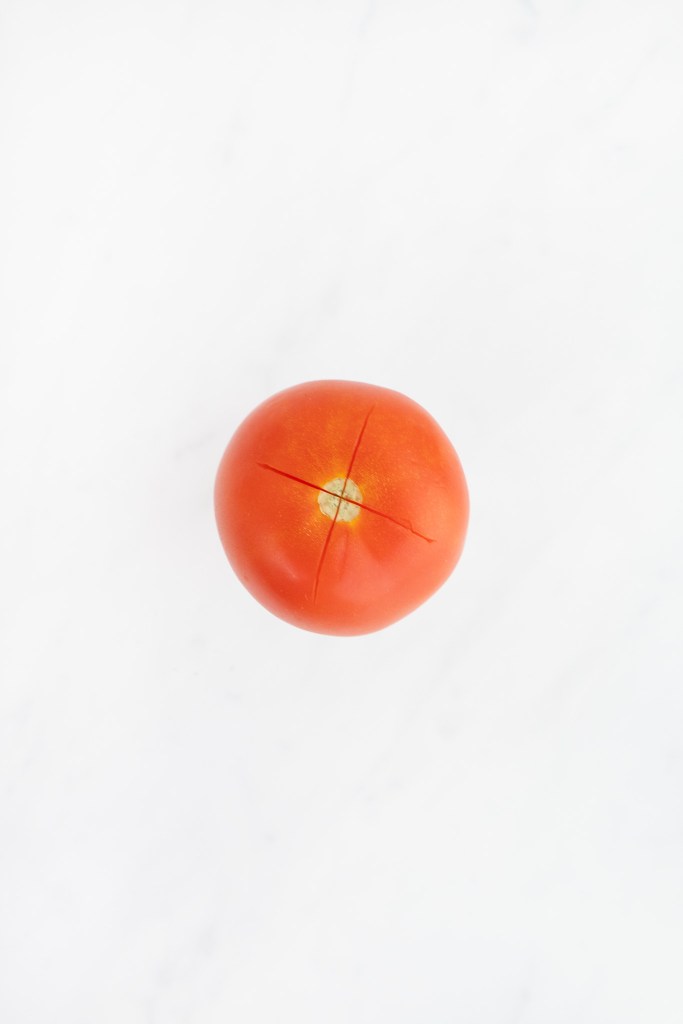
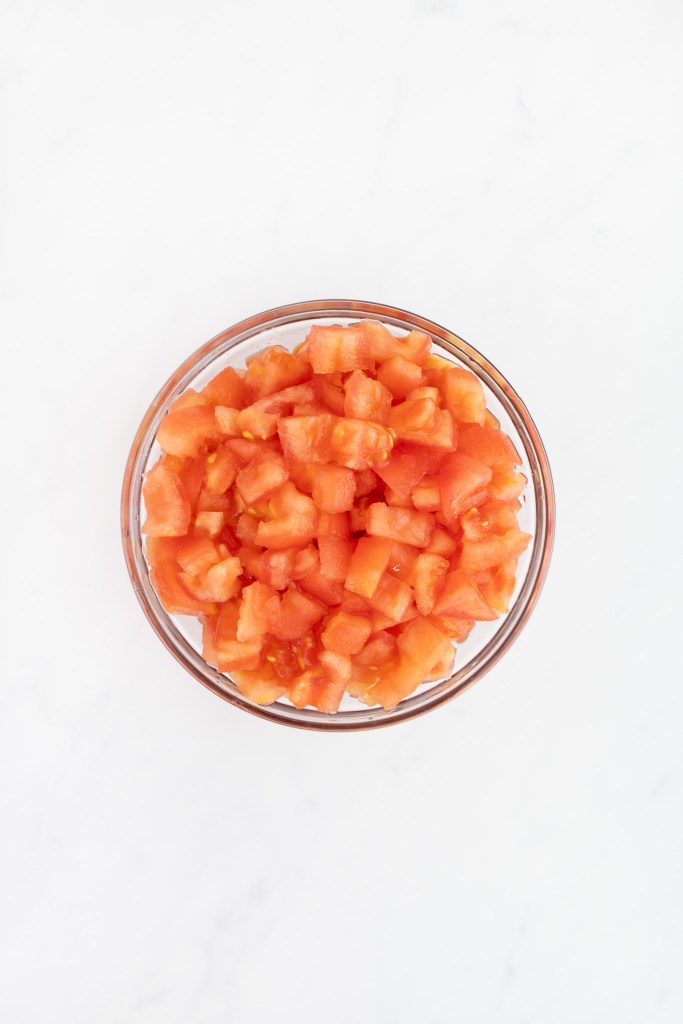
Before beginning, prepare your tomatoes by bringing a pot of water to a boil. Cut a small “X” into the top of each tomato, then submerge each into the boiling water for about 30 seconds until the skin begins to peel. Peel off the skin from each tomato, then finely chop them into ¼-inch dice and set them aside in a bowl.

Making the Paella
Note for cooking in a paella pan: A paella pan is traditionally much larger in diameter than a standard electric or gas burner. This means the parts of the pan directly over the burner will heat much hotter than the outer circumference. Be sure to stir each component so that everything cooks evenly.
In a 14” paella pan or skillet, heat the olive oil over medium heat. Add in the chorizo and cook until browned on both sides. Remove the chorizo using a slotted spoon and set aside in a bowl.

Next, add the chicken, ¼ tsp of kosher salt, and ¼ tsp of black pepper into the pan and cook until browned and fully cooked through. Once done, remove the chicken from the pan and place it into the same bowl with the chorizo.

Add in the chopped onion and bell pepper, ¼ tsp of kosher salt, and ¼ tsp of black pepper, and cook for about 5 to 8 minutes, until the veggies have softened.

Once the veggies have softened, add in the minced garlic and cook for 30 to 60 seconds, just until fragrant.
Add in the white wine and, using a wooden spoon or rubber spatula, scrape up any bits that may have stuck to the bottom of your pan.
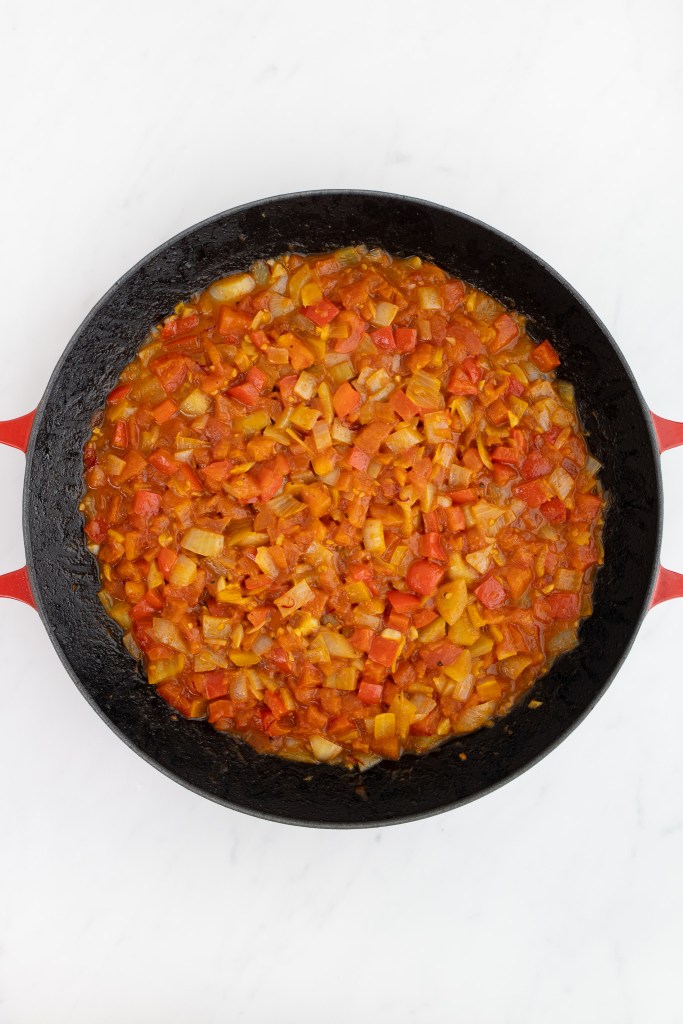
Next, stir in the tomatoes, saffron, smoked paprika, cayenne pepper, bay leaf, and 2 teaspoons of kosher salt. Bring the mixture to a low simmer, then reduce your heat to a medium-low and simmer for 15 to 20 minutes, stirring occasionally, until most of the tomato has dissolved into a sauce. Remove the bay leaf once finished. Fun fact: this sauce is called a sofrito!
In the meantime, preheat your oven to 400℉.
Turn the heat back up to medium and stir in the rice. Allow it to toast for 1 to 2 minutes, stirring constantly.
Stir the cooked chorizo and chicken back in, and then add in 4 cups of chicken stock. As soon as the stock goes in, stop stirring! Taste for seasonings and sprinkle over additional salt as necessary.

Bring the mixture to a simmer, then carefully transfer it into your preheated oven. Allow the paella to bake for about 25 minutes, until most of the liquid has been absorbed by the rice.
Important note: The exact time in the oven will vary greatly based on your oven and the material of your pan, so it’s best to check for the indicator (the liquid being absorbed) rather than relying on a time measurement.

Once most of the liquid has evaporated, add in an additional 1 cup of chicken stock and sprinkle the peas on top. Return the paella to the oven for another 10 minutes, until the liquid has again been absorbed.

Remove the paella from the oven and give the rice a taste test for doneness. If it is still a bit firm, add in additional chicken stock, ½ cup at a time, and repeat the process until tender. Note: the amount of chicken stock will vary based on the brand of rice you use, but typically 5 to 6 cups is enough for 2 cups of Bomba rice.
Once your rice is fully cooked, remove the paella from the oven, cover with aluminum foil, and set aside while you cook the seafood.
Preparing the Seafood
Combine the shrimp, olive oil, smoked paprika, and a sprinkle of salt and pepper in a bowl.

Heat up a separate pan or skillet on the stovetop and cook the shrimp for about 2 to 3 minutes on each side, until pink and fully cooked through. Remove them from the pan and set them aside in a bowl.

To the same pan you cooked the shrimp in, add in the white wine, 1 cup of chicken stock, and ¼ tsp of kosher salt, and bring the mixture to a boil. Add in the mussels, cover with a lid, and cook for about 5 minutes, until all the mussels have opened. For safety, discard any mussels that do not open after cooking. Remove the pan from the heat and set it aside while finishing the paella.

Developing the Socarrat and Serving
Once the seafood has cooked, uncover your paella and set it on the burner over high heat for about 5 minutes, moving the pan around to distribute the heat. This is to develop a crispy bottom (known as a socarrat).
Pro tip: Many recipes say to cook until you hear a crackle sound; however, I don’t find this to be a particularly reliable measure. There is inevitably an amount of guesswork involved in trying to achieve a socarrat. Trust your instincts… a light (or no) socarrat is better than a burnt paella!
Finally, gently push the shrimp and mussels into the top of the paella, as desired.

Sprinkle over chopped parsley and serve immediately with lemon wedges!
Leftovers safety: If you have any paella leftovers, I recommend eating all of the seafood the same day. Any remaining paella can be stored in an airtight container in the fridge for no more than 24 hours.

Spanish Mixed Paella (Paella Mixta)
Ingredients
For the Paella Base
- 4 Tbsp extra virgin olive oil
- ½ lb (227g) cured Spanish chorizo, cut into ¼" slices
- 4 boneless skinless chicken thighs, cut into chunks
- 1 large onion, peeled and ¼" diced
- 1 red bell pepper, washed and ¼" diced
- 4 cloves of garlic, peeled and minced
- ½ cup dry white wine
- 1 lb (about 4) Roma (plum) tomatoes, peeled and finely diced (see Step 1, below)
- ½ tsp (0.25g) saffron threads
- 1 tsp smoked paprika
- ¼ tsp ground cayenne pepper (up to ½ tsp if you like spice!)
- 1 bay leaf, whole
- Kosher salt (quantities in instructions; I use Diamond Crystal)
- Freshly cracked black pepper (quantities in instructions)
- 2 cups Bomba rice
- 5–6 cups low-sodium chicken stock
- ½ cup frozen peas, thawed
For the Seafood
- 10–12 large shrimp (21/25 count), peeled and deveined (if not already)
- 10–12 mussels, scrubbed and debearded
- 2 tsp extra virgin olive oil
- ½ tsp smoked paprika
- ¼ cup dry white wine
- 1 cup low-sodium chicken stock
For the Garnish
- Fresh parsley, finely chopped
- 1 large lemon, cut into wedges
Instructions
Preparing the Tomatoes
- Bring a pot of water to a boil. Cut a small “X” into the top of each tomato, then submerge them in the boiling water until the skin begins to peel (about 30 seconds). Carefully remove the tomatoes, peel off the skin, and finely chop them into a ¼" dice. Set aside in a bowl.1 lb (about 4) Roma (plum) tomatoes, peeled and finely diced
Making the Paella
- Note for cooking in a paella pan: A paella pan is traditionally much larger in diameter than a standard electric or gas burner. This means the center of the pan directly over the burner will heat much faster than the outer edges. Be sure to stir each component frequently during these early stages so everything cooks evenly.
- In a 14” paella pan or large skillet, heat the olive oil over medium heat. Add in the sliced chorizo and cook until browned on both sides. Remove the chorizo using a slotted spoon and set aside in a bowl.4 Tbsp extra virgin olive oil½ lb (227g) cured Spanish chorizo, cut into ¼" slices
- To the pan, add in the chicken, ¼ tsp of kosher salt, and ¼ tsp of black pepper. Cook until the chicken is browned and fully cooked through. Remove the chicken from the pan and place it into the same bowl with the chorizo.4 boneless skinless chicken thighs, cut into chunks
- To the pan, add in the chopped onion and bell pepper, ¼ tsp of kosher salt, and ¼ tsp of black pepper. Sauté until the vegetables have softened (about 5 to 8 minutes).1 large onion, peeled and ¼" diced1 red bell pepper, washed and ¼" diced
- Stir in the minced garlic and cook just until fragrant (about 30 to 60 seconds).4 cloves of garlic, peeled and minced
- Pour in the white wine. With a wooden spoon or rubber spatula, scrape up any browned bits stuck to the bottom of the pan.½ cup dry white wine
- Stir in the diced tomatoes, saffron, smoked paprika, cayenne pepper, bay leaf, and 2 tsp of kosher salt. Bring the mixture to a low simmer, then reduce the heat to medium-low. Simmer, stirring occasionally, until most of the tomato liquid has evaporated and dissolved into a thick sauce (about 15 to 20 minutes). Remove and discard the bay leaf. (Fun fact: this sauce is called a "sofrito"!)½ tsp (0.25g) saffron threads1 tsp smoked paprika¼ tsp ground cayenne pepper1 bay leaf, whole
- While the sofrito simmers, preheat the oven to 400℉.
- Turn the stovetop heat back up to medium and stir the Bomba rice into the sofrito. Allow the rice to toast, stirring constantly (about 1 to 2 minutes).2 cups Bomba rice
- Stir the cooked chorizo and chicken back into the pan, then pour in 4 cups of the chicken stock. As soon as the stock goes in, stop stirring completely! Taste for seasoning, and sprinkle over additional salt as necessary.
- Bring the mixture to a simmer on the stovetop, then carefully transfer the pan into the preheated oven. Bake until most of the liquid has been absorbed by the rice (about 25 minutes).Important note: The exact oven time will vary greatly based on your oven and the material of your pan. It is always best to check for the visual indicator (the liquid being absorbed) rather than relying strictly on a timer.
- Once most of the liquid has evaporated, pour in an additional 1 cup of chicken stock over the rice and sprinkle the thawed peas evenly on top. Return the paella to the oven to cook until the liquid has again been absorbed (about 10 minutes more).½ cup frozen peas, thawed
- Remove the paella from the oven and taste the rice for doneness. If it is still a bit too firm, add in additional chicken stock, ½ cup at a time, and return it to the oven briefly until tender.Note: The amount of chicken stock will vary based on the brand of rice, but 5 to 6 total cups is usually enough for 2 cups of Bomba rice.
- Once the rice is fully cooked and perfectly tender, remove the paella from the oven, cover with aluminum foil, and set it aside while you cook the seafood.
Preparing the Seafood
- In a medium bowl, toss the shrimp with the olive oil, smoked paprika, and a pinch of salt and pepper.10–12 large shrimp (21/25 count), peeled and deveined (if not already)2 tsp extra virgin olive oil½ tsp smoked paprika
- Heat a separate pan or skillet on the stovetop over medium-high heat. Add in the shrimp and cook until pink and fully cooked through (about 2 to 3 minutes on each side). Transfer the shrimp into a bowl and set aside.
- To the same pan, pour in the white wine, chicken stock, and ¼ tsp of kosher salt. Bring the mixture to a boil. Add in the mussels, cover with a lid, and steam until all the mussels have opened (about 5 minutes). Remove the pan from the heat and set aside.Safety note: Discard any mussels that do not open after cooking.¼ cup dry white wine1 cup low-sodium chicken stock10–12 mussels, scrubbed and debearded
Developing the Socarrat and Serving
- Once the seafood is cooked, uncover your paella and place it back on the stovetop over high heat. Cook for about 5 minutes, carefully shifting the pan around to distribute the heat evenly across the bottom. (This process develops the crispy rice bottom known as the "soccarat".)Pro tip: Many recipes indicate to cook until you hear a crackle sound, but I don’t find this to be a particularly reliable measure. There is inevitably an amount of guesswork involved in trying to achieve the perfect socarrat. Trust your instincts — a light socarrat (or none at all) is better than a burnt paella!
- Arrange the cooked shrimp and steamed mussels on top of the paella, gently pressing them into the rice, as desired. Garnish generously with finely chopped fresh parsley and serve immediately with fresh lemon wedges.Leftovers safety: If you have leftovers, I recommend eating all of the seafood on the same day. Store any remaining rice and meat in an airtight container in the refrigerator for no more than 24 hours.Fresh parsley, finely chopped1 large lemon, cut into wedges