Traditional Puff Pastry (Pâte Feuilletée)
This step-by-step guide will teach you how to make traditional puff pastry from scratch. Though the process requires a bit of time and patience, making homemade puff pastry is one of the most rewarding baking projects you can tackle. The result is a super flaky, crisp, and buttery pastry well worth the effort.
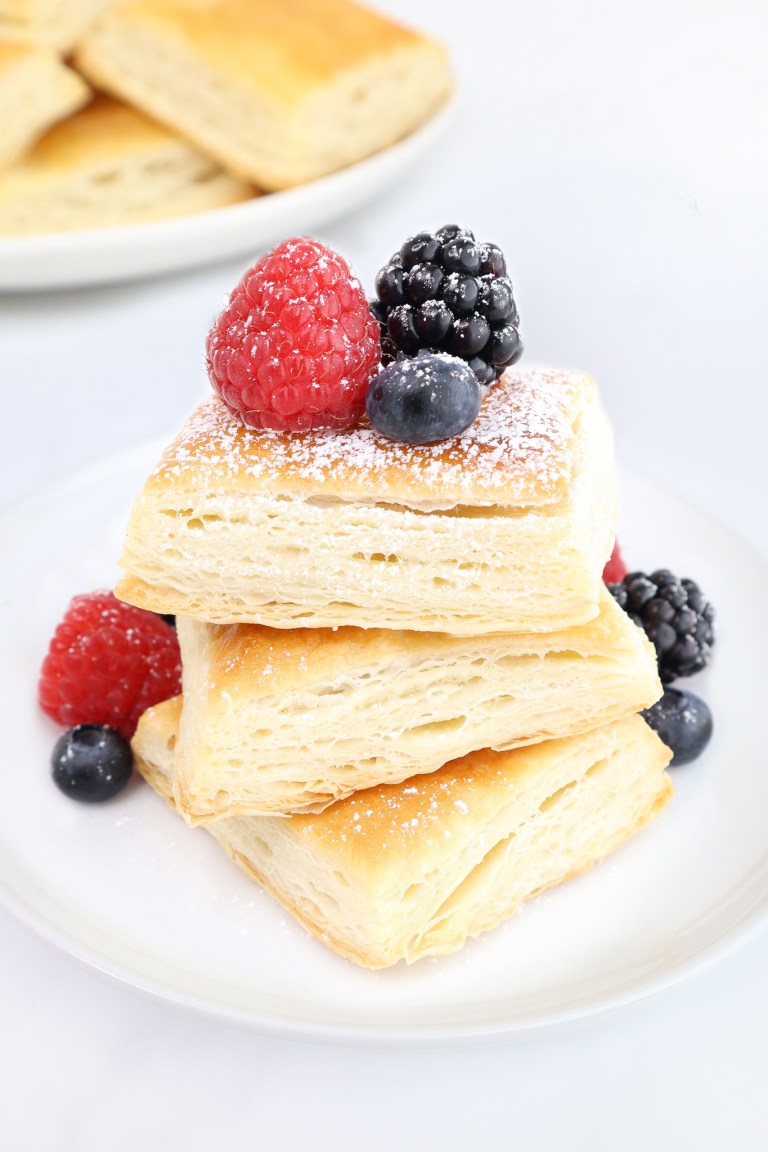
Ingredients
For the Détrempe (Base Dough)
- 3 ½ cups all-purpose flour
- 2 Tbsp granulated sugar
- 1 ½ tsp kosher salt (I use Diamond Crystal)
- 1 cup cold water
- 4 Tbsp unsalted butter, chilled
For the Beurrage (Butter Block)
- 1 ½ cups (3 sticks) unsalted butter, chilled
Instructions
- Note: I highly encourage you to scroll up and look through the step-by-step photos above to help guide you along the way.
Preparing the Détrompe (Base Dough)
- In the bowl of a stand mixer fitted with the paddle attachment, add in the flour, sugar, and salt. Mix on low speed until combined (about 30 seconds).3 ½ cups all-purpose flour2 Tbsp granulated sugar1 ½ tsp kosher salt
- Cut the butter into ¼" cubes and add into bowl.4 Tbsp unsalted butter, chilled
- Mix on medium speed until no lumps of butter remain, and the mixture has a sandy texture (about 3 minutes — longer than you think).
- Reduce the mixer to low speed and slowly add in the cold water. Mix just until the dough comes together (about 20 seconds). Note: the dough should still be fairly dry; if there is still loose flour in the mixture, add in a few drops more water and finish mixing by hand.1 cup cold water
- Pour out the dough on a lightly floured surface. Compress it into a ball by pressing it together firmly with both hands.
- With your hands, gently knead the dough until it forms a smooth mass. Be careful not to over-knead.
- Wrap the dough in plastic wrap. Set it in the refrigerator to chill while preparing the butter block.
Preparing the Beurrage (Butter Block)
- Prepare a piece of parchment paper about 18" long. In the center, trace an 8" square. (Tracing around a cut-out 8" piece of cardboard works well.)
- Turn the parchment paper over (so any pen/pencil marks don't get into the butter) and pre-fold all four sides of the parchment paper along the drawn lines.
- With a rolling pin, whack the chilled butter until it is malleable and spreadable, but still cold.1 ½ cups (3 sticks) unsalted butter, chilled
- Place the butter into the center of the traced-out square and fold all four sides of the parchment paper up over the butter. Using the rolling pin, continue to roll out and form the butter into a square, pressing the butter into the corners with your fingers. With a cutting board (or any heavy flat object), press down on the butter block to ensure uniform thickness.
- Set the entire parchment paper "package" (containing the butter block) in the refrigerator.
Laminating (or Forming) the Dough
- Remove the détrempe (base dough) from the refrigerator and set it on a lightly floured surface.
- Using your fingers, gently shape the dough into a square shape.
- Using a rolling pin, roll the dough out into a 12" square.Pro tip: To keep the dough in a square shape, roll the dough from its center out towards each corner, in an "X" pattern.
- Remove the beurrage (butter block) from the refrigerator and place it in the center of the dough at a 45° angle (so it looks like a diamond in a square).
- Fold the edges of the dough up over the butter block, pressing the edges together to completely seal in the butter. Turn the dough back 45° to its original orientation.
- With the rolling pin, roll out the dough (seam-side up) into a rectangle at least twice as long as it is wide (about 20" by 10").
- Fold the dough horizontally in thirds like a business letter: fold the top third down, followed by the bottom third up.
- Rotate the dough 90° clockwise (i.e. a ¼ turn to the right), as if the dough was a book that could be opened. This folding and rotating process is called a "turn".
- Once again, roll out the dough into a rectangle at least as twice as long as it is wide (about 20" by 10") and repeat the folding process. This is the second turn.
- Wrap the dough in plastic wrap. Place the wrapped dough in the refrigerator until it is chilled and well rested (at least 1 hour).
- Remove the dough from the refrigerator and repeat the above folding process to make two additional turns. Wrap the dough in plastic wrap (the same piece is fine) and let it rest in the refrigerator for at least another hour.
- Repeat the folding process one more time to make two additional turns (six turns in total). Return the dough to the refrigerator to chill for at least one more hour. Afterwards, the dough can be baked into puff pastry or stored in the refrigerator or freezer for future use.
Baking the Puff Pastry
- With a rolling pin, roll out the dough into a ¼" to ⅛" thickness (about 18" by 12").
- Trim off about ¼" on all four sides. (This takes off the folded edges to ensure that it puffs properly in the oven.)
- Cut dough into desired shape(s), according to whichever recipe you are using. Bake as directed.
- To save and store any remaining dough, carefully fold it back up like a business letter, wrap it in plastic wrap or a resealable plastic bag, and refrigerate.
Storing the Puff Pastry
- To store puff pastry, refrigerate for up to several days or freeze for up to six months. To use from frozen, allow dough to thaw in the refrigerator overnight.
Nutrition
Calories: 4496kcal | Carbohydrates: 358g | Protein: 49g | Fat: 322g | Saturated Fat: 202g | Polyunsaturated Fat: 14g | Monounsaturated Fat: 83g | Trans Fat: 13g | Cholesterol: 843mg | Sodium: 3552mg | Potassium: 563mg | Fiber: 12g | Sugar: 25g | Vitamin A: 9805IU | Calcium: 169mg | Iron: 20mg