Profiteroles (Foolproof Pâte à Choux)
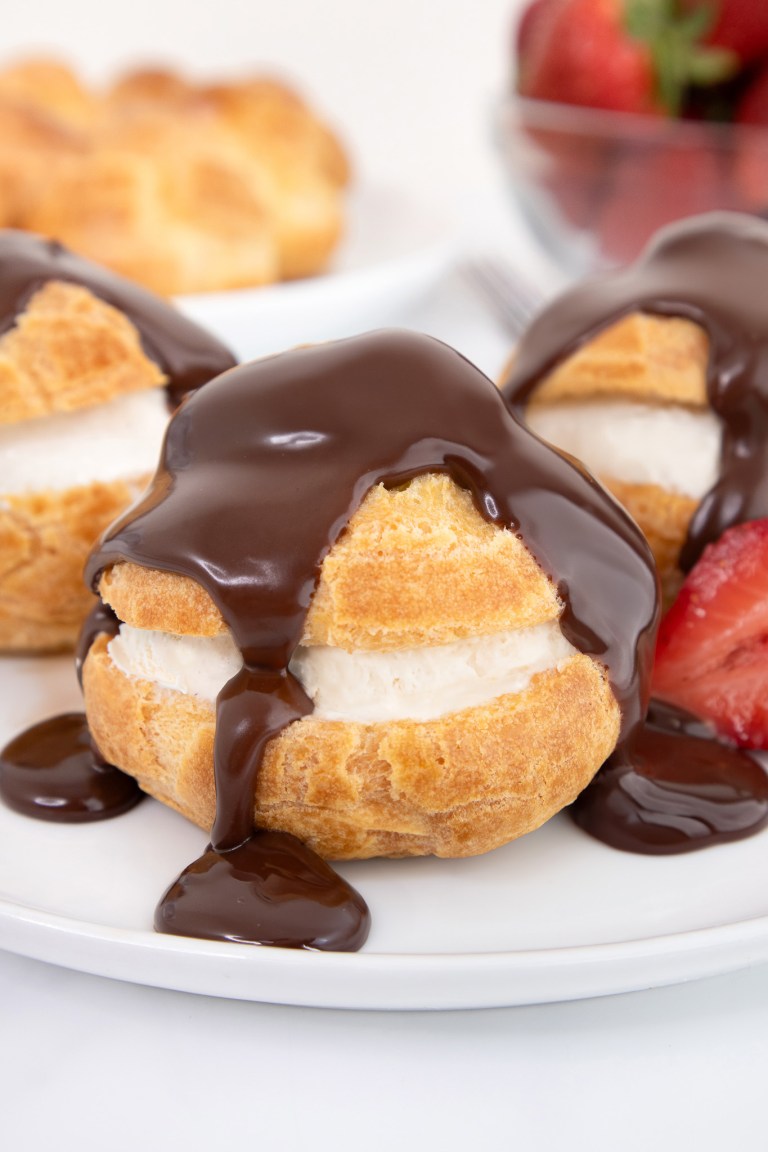
These crisp and buttery profiteroles are filled with ice cream and topped with a warm, silky chocolate sauce. This recipe covers all of the basics to making the perfect pâte à choux (choux pastry) that won’t collapse or get soggy!
Ingredients
For the Choux Pastry Dough (Pâte à Choux)
- ½ cup milk
- ½ cup water
- ½ cup (1 stick) unsalted butter
- 1 Tbsp granulated sugar
- ½ tsp kosher salt (I use Diamond Crystal)
- 1 cup all-purpose flour (spooned and leveled)
- 4 large eggs, at room temperature
- 1 additional large egg (for the egg wash)
For the Filling
- Good-quality ice cream
For the Chocolate Sauce
- 10 oz semi-sweet chocolate
- 1 cup heavy cream
- 2 Tbsp Kahlúa coffee liqueur (optional)
Equipment
- Perforated Baking Mat (I use this one)
Instructions
Preparing the Choux Pastry Dough (Pâte à Choux)
- Preheat oven to 425℉.
- If using parchment paper, trace twelve 1 ½" to 2" circles on two pieces of parchment paper cut to the size of a baking sheet. The circles should be spaced apart (at least 1 ½") on all sides.Alternatively, set a perforated baking mat (with circle guides) on a baking sheet. This is the one I use.
- In a medium-sized saucepan, combine milk, water, butter, sugar, and salt. Heat over medium heat just until the mixture comes to a boil.½ cup milk½ cup water½ cup (1 stick) unsalted butter1 Tbsp granulated sugar½ tsp kosher salt
- Remove the saucepan from the heat and pour in flour (all at once). With a wooden spoon, stir vigorously until the dough comes together.1 cup all-purpose flour
- Set the saucepan back over medium heat and continue to stir vigorously until the dough begins to form a film on the bottom of the saucepan (about 1 to 2 minutes).
- Remove the pan from heat and empty the dough into the bowl of a stand mixer fitted with the paddle attachment (or, alternatively, a large clean bowl, continuing on using the wooden spoon).
- Mix on low speed for 1 minute, allowing the dough to cool slightly and for the steam to escape.
- With the mixer still on low speed, add in eggs, one at a time. (Don't worry if the dough looks lumpy and curdled; it will eventually come together.)4 large eggs, at room temperature
- When all the eggs have been incorporated, slowly increase the mixing speed to high. Mix on high speed until the dough comes together. Scrape down the sides of the bowl, then continue to mix on high for 1 minute more.Pro tip: The dough should appear glossy. It should also be thick enough to cling to the paddle attachment, but slowly drip off when lifted from the bowl. If it is too thick, whisk a 5th egg in a small bowl and slowly drizzle it into the bowl, while mixing, until the dough reaches the right consistency. (However, it is better to have a stiffer dough than an runny one, so I recommend erring on the safe side and not adding in too much more egg.)
- Spoon the dough into a large piping bag (or large zipper storage bag) and cut the tip to create a hole about ¾" in diameter. To help remove air pockets, gently squeeze and twist the bag.Pro tip: If using parchment paper, you can use a small amount of dough to adhere the parchment paper to the baking sheet at all four corners (to prevent it from sliding).
- Onto the parchment paper (with the traced circles facing down to prevent the markings from transferring) or the baking mat, pipe the dough into 1 ½"- to 2"-wide mounds about 1" tall. (I recommend baking one batch at a time on a single pan.)Pro tip: To make the proper shape, hold the piping bag straight up and down in the center of the circle and, using an even pressure, squeeze while slowly moving the bag away from the mat or paper. (Do not pipe the dough into a spiral or coil — they will not puff up properly.)

- To prevent sharp peaks that will inevitably cook faster (and burn in the oven), dip your finger in water and gently press down on the tops of each mound.
- In a small bowl, whisk egg and 1 tsp of water until homogenous. Lightly brush each dough mound with egg wash.1 additional large egg
- Set baking sheet in center of preheated oven, quickly closing the oven door to prevent heat from escaping. Bake at 425℉ for 15 minutes, then immediately turn down oven temperature to 350℉ and bake for an additional 15 minutes. (Note: Do not open the oven during baking!)Pro tip: To avoid having to open the oven door (to switch and rotate multiple pans), I recommend baking one batch at a time on a single pan, leaving the oven door closed for the entire 30 minutes.
- Remove baking sheet from oven and allow profiteroles to cool until they can be handled (about 5 minutes). Using a sharp knife, poke a hole into the side of each profiterole (to allow steam to escape). Set profiteroles onto a cooling rack to cool completely. If desired, freeze in airtight containers or zipper storage bags, heating them in a 425℉ oven for 5 minutes when ready to serve.Pro tip: I like to let the finished profiteroles sit out for several hours to ensure that the centers have fully dried out before serving them.
- Repeat steps 11 to 15 with subsequent batches, remembering to increase the oven temperature back up to 425℉.
Preparing the Chocolate Sauce
- Create a double boiler by setting a heat-proof bowl over a pot of simmering water. Add in cream, then chocolate. Heat mixture, stirring constantly, until the chocolate is smooth and fully melted.1 cup heavy cream10 oz semi-sweet chocolate
- Remove from heat and, optionally, stir in Kahlùa. Allow the chocolate sauce to cool slightly (it will thicken as it cools).2 Tbsp Kahlúa coffee liqueur
Assembling and Serving the Profiteroles
- When ready to serve, cut each profiterole in half. Using a small cookie, scoop a small amount of ice cream into the center of each.Good-quality ice cream
- Drizzle the top of each profiterole with chocolate sauce. Serve immediately.Pro tip: Leftover chocolate sauce can be reheated over a double boiler (as before) or in the microwave for short bursts of 10 to 15 seconds, until warm and loosened.
Notes
- Freezing Profiteroles: Once cooled, place the profiteroles into an airtight container or zipper storage bag and freeze them for up to 3 months. When ready to serve, place them in a 425℉ oven for about 5 minutes to defrost.
Nutrition
Calories: 247kcal | Carbohydrates: 20g | Protein: 4g | Fat: 17g | Saturated Fat: 10g | Polyunsaturated Fat: 1g | Monounsaturated Fat: 5g | Trans Fat: 0.2g | Cholesterol: 76mg | Sodium: 96mg | Potassium: 171mg | Fiber: 1g | Sugar: 13g | Vitamin A: 473IU | Vitamin C: 0.3mg | Calcium: 70mg | Iron: 1mg