A WORD OF ENCOURAGEMENT
Croissants are one of the most challenging baking projects, even for the most experienced pastry chefs. They certainly don’t fall into the “quick and easy” category, and any recipe claiming otherwise is either cutting corners or not delivering truly authentic croissants. This process takes time and patience, but the results are absolutely worth it!
As an avid home baker, I like to think of croissants as a fun weekend project. Not only do you get to enjoy a delicious, flaky piece of heaven as a reward, but you also walk away with a new skill set that you can take pride in.
I tested and developed this recipe as a guide to help you overcome some of the most common mishaps when making croissants at home with everyday ingredients. But remember, like anything else, it takes practice to perfect, so don’t get discouraged if your first batch doesn’t look like something straight out of a bakery in Paris. Even if you make a mistake, or they don’t turn out as perfectly as you may have hoped, you’ll still end up with something delicious!
TIPS FOR MAKING THE PERFECT BAKERY-STYLE CROISSANTS
- Measure the ingredients carefully: For a particularly complicated recipe like croissants, it’s important to measure your ingredients precisely. For the best results, I recommend measuring the ingredients by weight, especially the flour and liquid ingredients, to ensure your dough has the proper texture. If you don’t have a kitchen scale, I have found the best way to measure flour is to sift it over your measuring cup and level it off with a knife.
- Use good-quality European-style butter: European-style butter has a higher fat content (less water), which makes it more pliable, even when chilled. This helps it spread evenly without cracking into pieces during the lamination process.
- Keep the dough as rectangular as possible: When laminating the dough, try to keep it as rectangular as possible. This ensures the butter is uniformly distributed throughout the dough, resulting in flaky croissants that expand evenly.
- Have patience: Allowing your croissant dough plenty of time to rest and rise is essential for developing the right texture and flavor, ensuring the croissants bake (and taste) as they should.
- Don’t get discouraged: Croissants are one of the most challenging baked goods to make that even the best of pastry chefs struggle with. If they don’t turn out perfectly on your first attempt, don’t get discouraged!
HOW LONG DOES IT TAKE TO MAKE AUTHENTIC CROISSANTS?
It takes at least two days to make authentic, bakery-style croissants. This may seem intimidating, but I’ve broken the process down into manageable steps.
Here’s an overview of all the steps to help you plan ahead (includes rising and/or resting time):
Day 1: Preparing the Croissant Dough (8 hours total)
- Preparing the dough (détrempe): 30 minutes
- First rise & preparing the butter block (beurrage): 1 – 1 ½ hours
- Second rise: 4 hours (or overnight)
- Laminating the dough (one double turn): 1 ½ hours
- Laminating the dough again (one single turn): 30 minutes
- Overnight rest
Day 2: Shaping & Baking the Croissants (3 hours total)
- Cutting & shaping the croissants: 30 minutes
- Final rise: 2 hours
- Egg wash & baking: 25 minutes
COMMON QUESTIONS ABOUT BAKING CROISSANTS
1. Why does butter pool or leak out in the pan when baking croissants?
Butter can leak out and pool in the pan during baking for several reasons: the butter may have gotten too warm during lamination, the croissants could have been under-proofed or proofed at too high a temperature, or the oven temperature might have been too low. However, if this happens, don’t worry — your croissants will still come out delicious! Just be sure to remove them from the pan (and out of any pooled butter) as soon as they come out of the oven.
2. Why did my croissants spread in the oven?
If your croissants spread in the oven, it could be due to issues during lamination, such as unevenly distributed butter between the layers of dough, or they may have been over-proofed before baking.
3. Why aren’t my croissants flaky?
If your croissants aren’t flaky, it is likely because the butter got too warm and soft during lamination. The goal of lamination is to have thin layers of butter between thin layers of dough, which puff up as they bake and create all of those flaky layers. When the butter becomes too warm, it can be incorporated into the dough rather than remaining as separate layers. To avoid this, keep everything as chilled as possible while you work.
4. Can I freeze croissant dough?
Yes, you can freeze croissant dough at almost any point in the process, up until just before the final proofing. Simply wrap the dough tightly in plastic wrap and place it in an airtight freezer bag. When you’re ready to continue, allow the dough to thaw in the fridge overnight before continuing where you left off in the process.
5. Can I freeze baked croissants?
Absolutely! I actually recommend freezing any leftover croissants as soon as possible (even day-of!) to prevent them from drying out. Just place them in an airtight freezer bag and store them in the freezer for up to three months. When you’re ready to enjoy them, you can simply let them thaw on the counter or reheat them in the oven for a few minutes.

— DAY ONE —
PROOFING THE YEAST
In a small bowl, whisk together the tepid water, sugar, and yeast with a fork. Allow the mixture to sit at room temperature for at least 5 minutes, or until the yeast granules have all dissolved and the mixture has begun to foam.
Note: Always be sure to check the expiry date on your packet of yeast to ensure that it hasn’t expired.

PREPARING THE CROISSANT DOUGH (Détrempe)
In the bowl of a stand mixer, whisk together the flour, salt and sugar.
Note: It is very important for this recipe to measure your flour as accurately as possible. Accordingly, I recommend using a kitchen scale to weigh your flour. If you don’t have one, I have found the next best way is to sift the flour into your measuring cup, then level it off with the back of a knife.
Using the dough hook attachment, turn the mixer to a low speed and pour in the water, milk, and yeast mixture. Continue to mix on low, stopping to scrape down the sides of the bowl as necessary, until the dough just comes together. The dough will appear dry at first, but should come together after about 5 minutes, at which point it should not have any dry patches of flour.
Note: It is important at this point to ensure that your dough is properly hydrated. The flour you use, the way you measure your ingredients, and even the weather can affect the final result. If the dough appears dry (and there are still dry patches of flour remaining), add in an additional Tablespoon or so of water. Alternatively, if the dough appears too soft or gummy in texture, sprinkle in a bit of extra flour.
Once the dough has come together, turn the mixer off, cover the bowl with a tea towel, and allow the flour to continue to hydrate for 10 minutes.
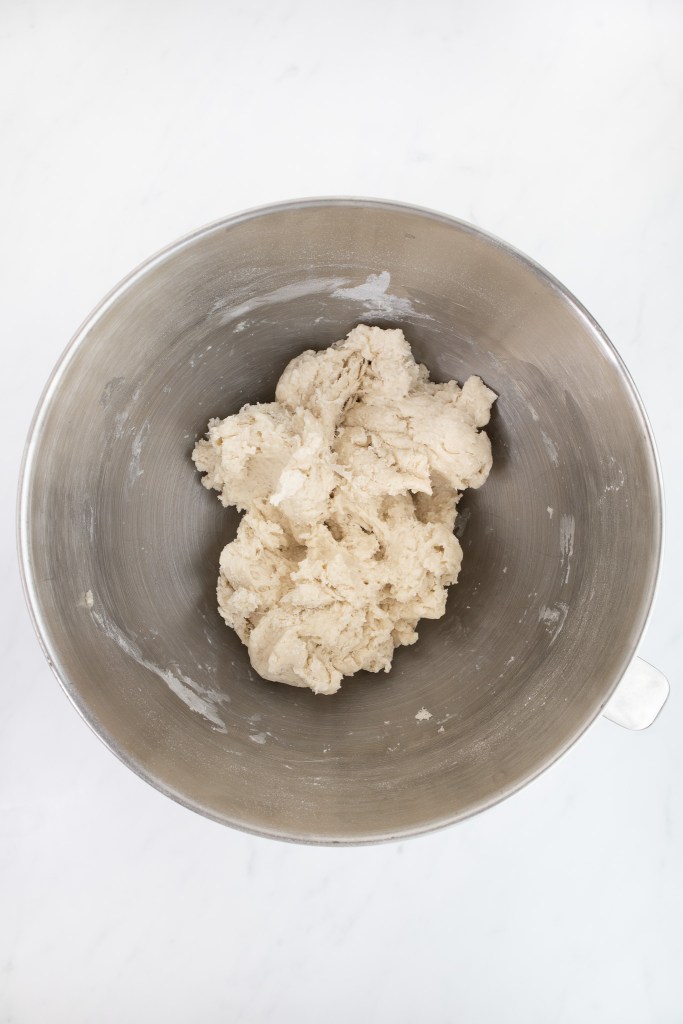
After the dough has rested for 5 minutes, turn the mixer back on to a medium-low speed and add in the cubes of chilled butter all at once. Continue to mix for about 5 to 10 minutes, until all of the butter has been incorporated into the dough (it may seem like it won’t at first — just keep going!). Continue to mix until the dough is smooth, stretchy, and no longer sticky to the touch.
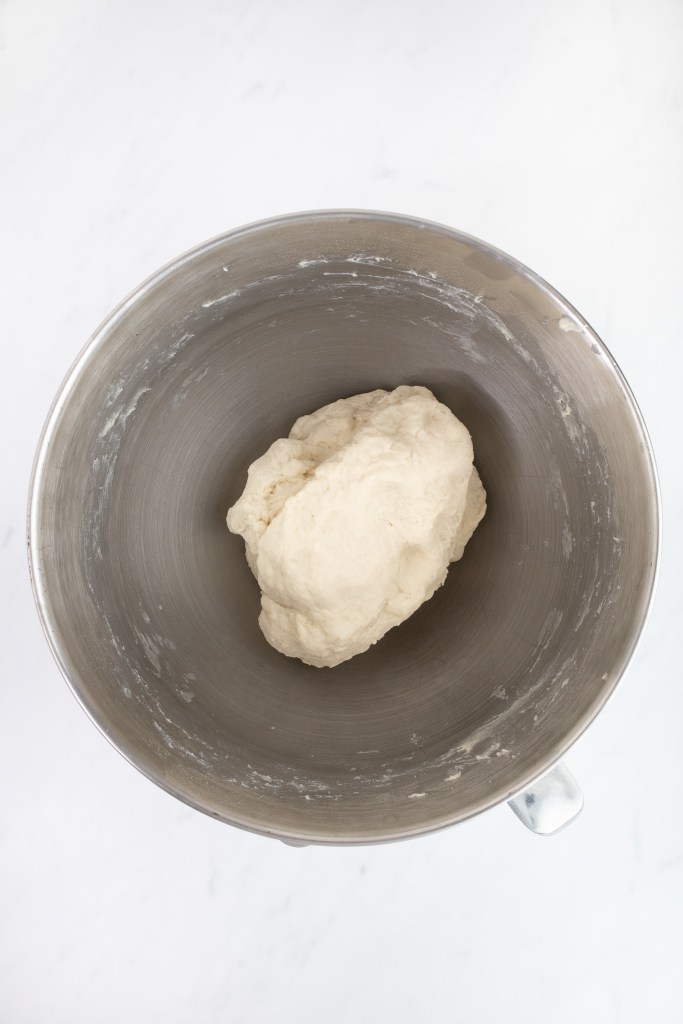
Remove the dough from the mixer and knead it by hand 2 to 3 times to form it into a smooth ball. Place the dough ball back into the bowl (seam side down), cover the bowl with plastic wrap and a tea towel, and allow it to rise at room temperature for 1 to 1 ½ hours, until the dough is roughly 1 ½ to 2 times its volume.


After the dough has had its first rise, using your hands, deflate the dough, knead it 2 to 3 times, reform it into another smooth ball, and place it back into the bowl. Cover the bowl once again with plastic wrap and a tea towel, and place it into the fridge to rise for at least 4 hours (and up to 12 hours). In the meantime, I recommend preparing the butter block.
PREPARING THE BUTTER BLOCK (Beurrage)
Cut a piece of parchment paper out to about 18″ in length. In the centre of the parchment paper, trace a square that is exactly 8″ by 8”.

Turn the parchment paper over (so any pencil markings won’t get into the butter), and place the chilled butter in the centre of the square. Fold the parchment paper over the butter and, using a rolling pin, begin beating and rolling the butter so that it forms a perfect 8” by 8” square of even thickness inside the parchment paper.
Pro tip: European-style butter has a higher fat content than regular butter, which makes it more pliable (even when chilled) and thus perfect for lamination. If you’re struggling to shape the butter into a square, you can allow it to sit at room temperature for a few minutes so that it is still chilled, but not room temperature. Note that the butter will begin to warm up faster the thinner you roll it out.


Place the butter square back into the fridge while your dough continues to rise.
LAMINATING THE DOUGH (one double turn)
Remove the dough from the fridge, place it on a lightly floured surface. Using your hands, pat the dough down and shape it into a rough square shape.
Using a rolling pin, begin rolling the dough out into a square shape that is at least 10” by 10”, trying your best to keep the edges as straight as possible. I find the easiest way to do this is to roll in an “X” motion, starting from the centre of the dough and rolling out towards each corner.
Using two pieces of plastic wrap placed perpendicular to one another, wrap the dough and continue rolling it out into the corners created by the plastic wrap (similar to the way you formed the butter block).
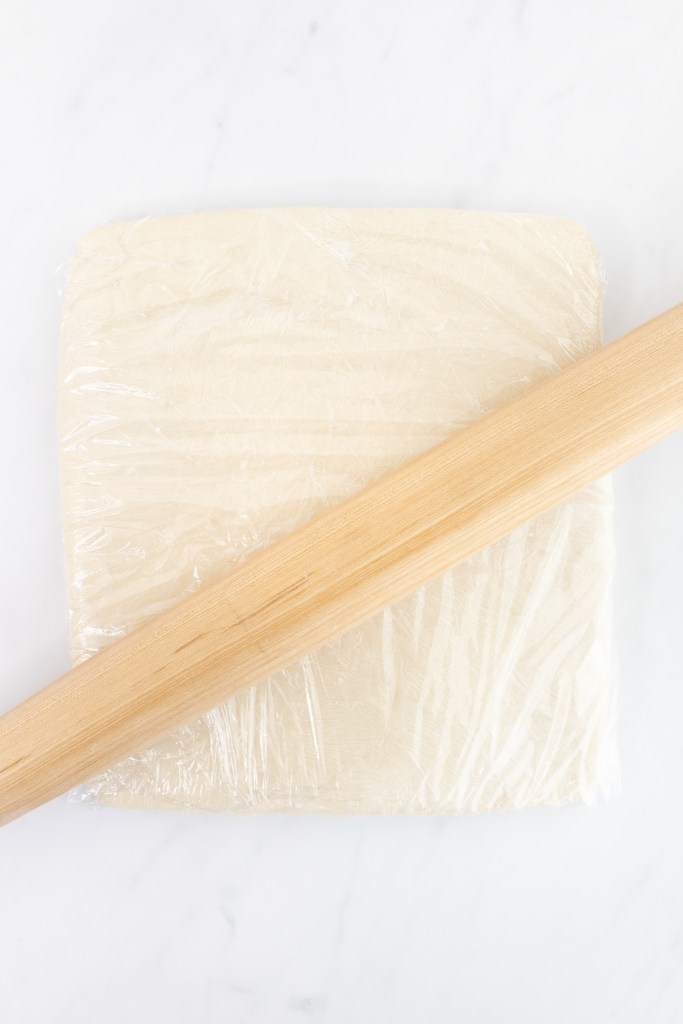
Place the dough on a cutting board or sheet pan and place it in the freezer for 20 minutes. After 10 minutes, remove your butter block from the fridge and set aside.
Note: The goal here is to have the dough and the butter be as similar in texture as possible. Chilling the dough in the freezer allows it to firm up slightly to be closer to the firmness of the butter. Similarly, allowing the butter to warm up slightly will make it more similar to the softness of the dough. However, keep in mind the butter must remain chilled, so be sure to work quickly yet carefully.
After the dough has chilled, remove it from the freezer, remove the plastic wrap, place it once again on a lightly floured surface, and roll the dough out to a square that is slightly larger than 12” by 12”.
Unwrap the butter block and place it in the centre of the dough, rotated 45 degrees to form a diamond shape.

Fold the edges of the dough up and over the butter block, taking extra time and care to stretch and pinch the seams together so that the butter is completely enveloped and won’t leak out when the dough is rolled.

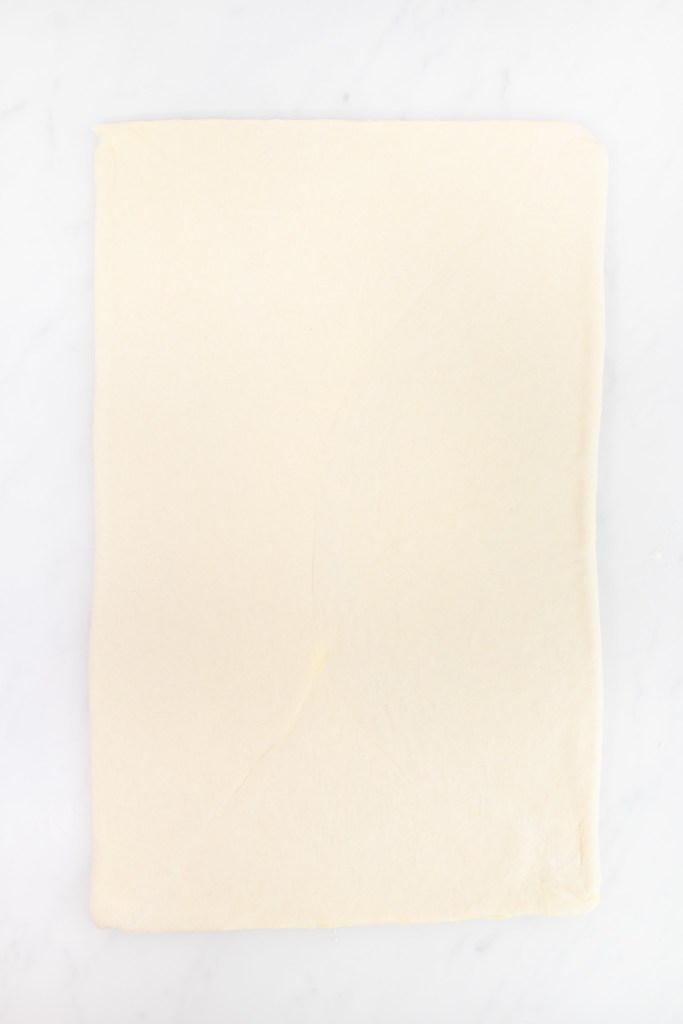
Roll the dough out so that it forms a rectangle that is roughly 12” by 18”, again trying to maintain a rectangular shape with straight edges as much as possible. Be sure to keep lifting the dough so that it does not stick to your counter!
Pro tip: If your dough begins to resist you and contract, you can wait a few minutes before you continue rolling, but be careful not to wait too long or the butter may get too warm! On the other hand, if you feel your dough is getting too warm, you can place it on a sheet pan and into the fridge for a few minutes before proceeding.
Using a pastry cutter, pizza cutter, or a sharp knife, trim off any rounded edges on both of the short ends of your rectangle.
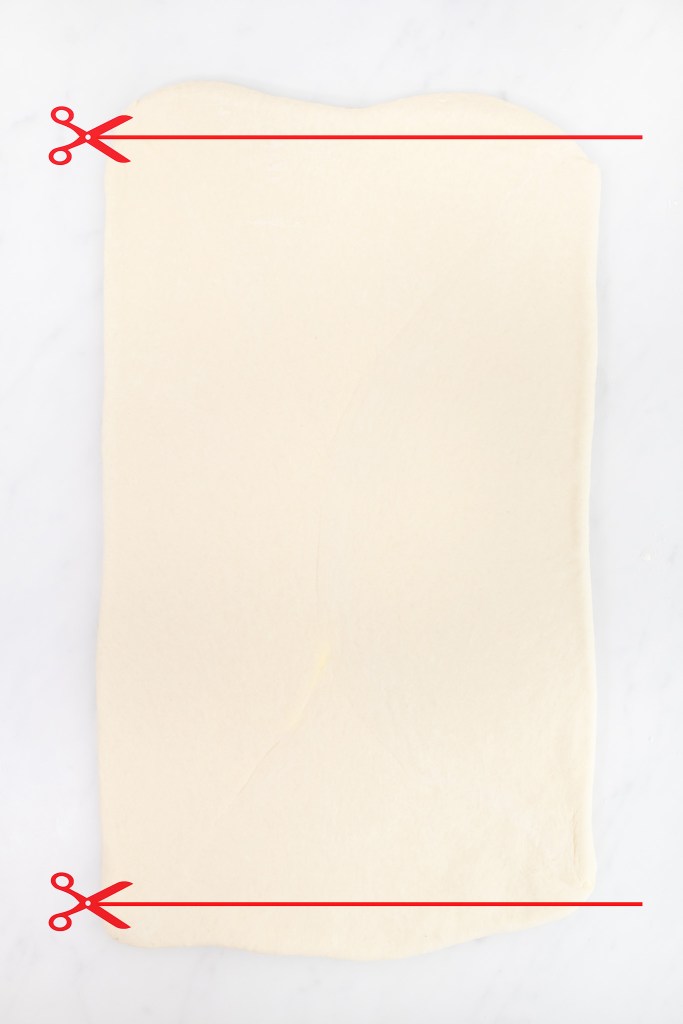
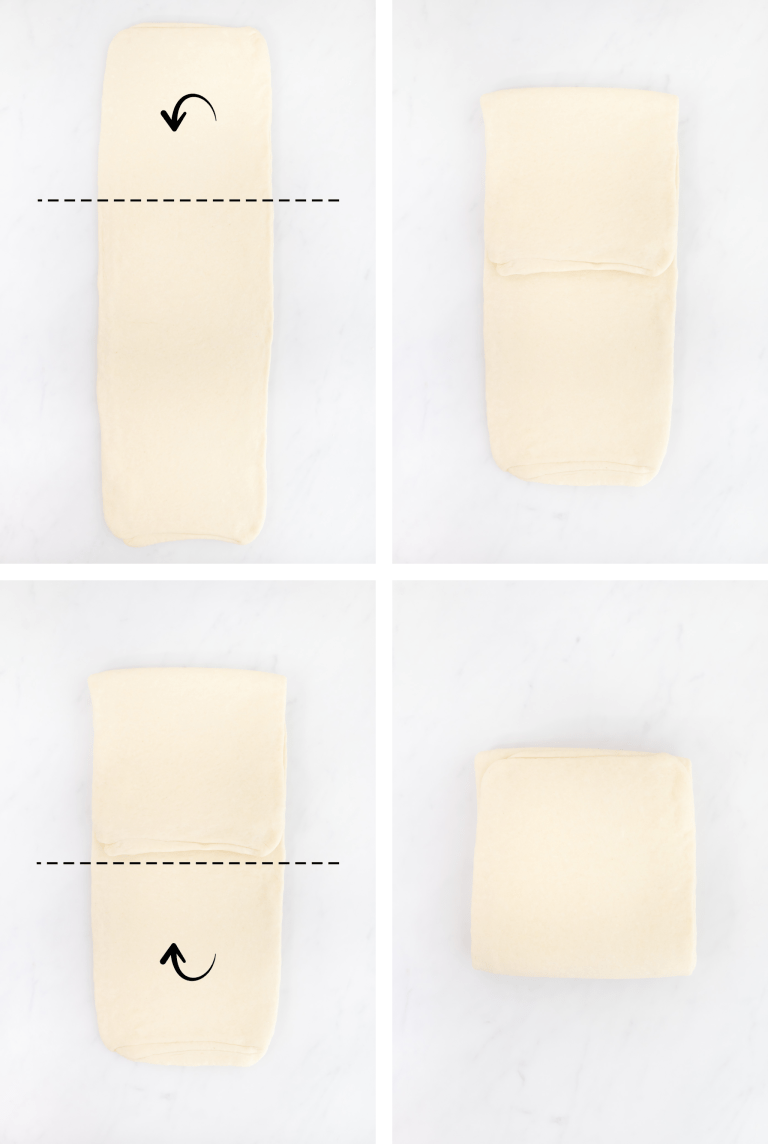
Fold both short ends to up to the centreline of the dough and pinch together the middle seam.
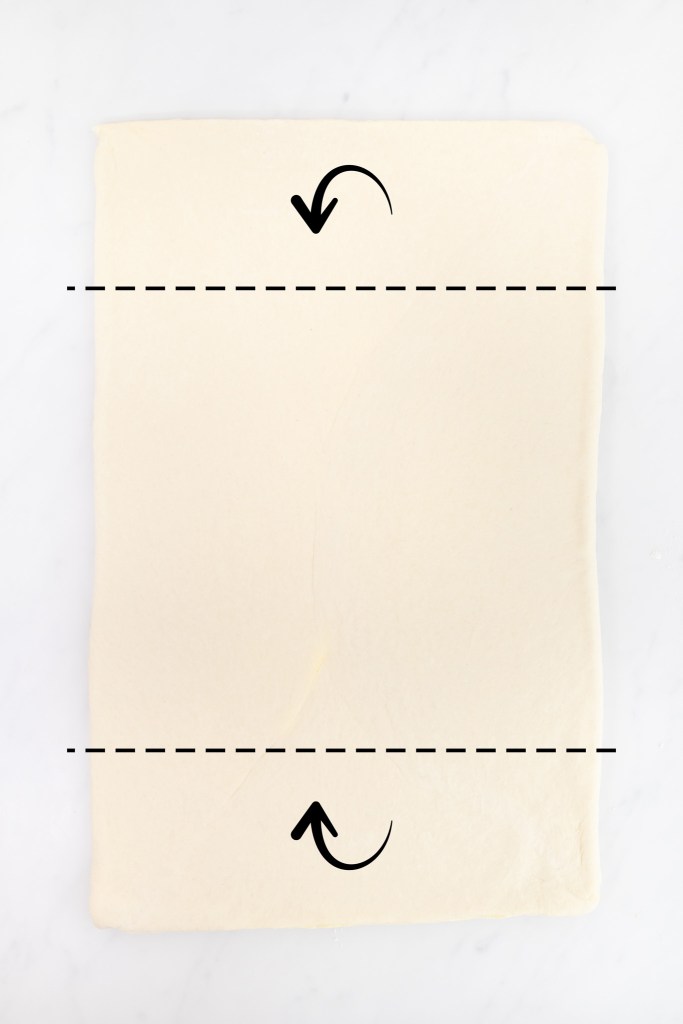

Next, fold the dough in half along the middle seam, like closing a book towards you.

Wrap the dough in plastic wrap and place it in the fridge to rest for 1 hour.
LAMINATING THE DOUGH AGAIN (one single turn)
Remove the dough from the fridge and place it on a lightly floured surface. Pat the dough down with your hands and gently pop any air bubbles that may have formed.
Place the dough vertically in front of you (up and down) and roll the dough out into a rectangular shape about 8” by 24”. The dough may, again, begin to resist you — if this happens, just give it a couple of minutes as you did above.

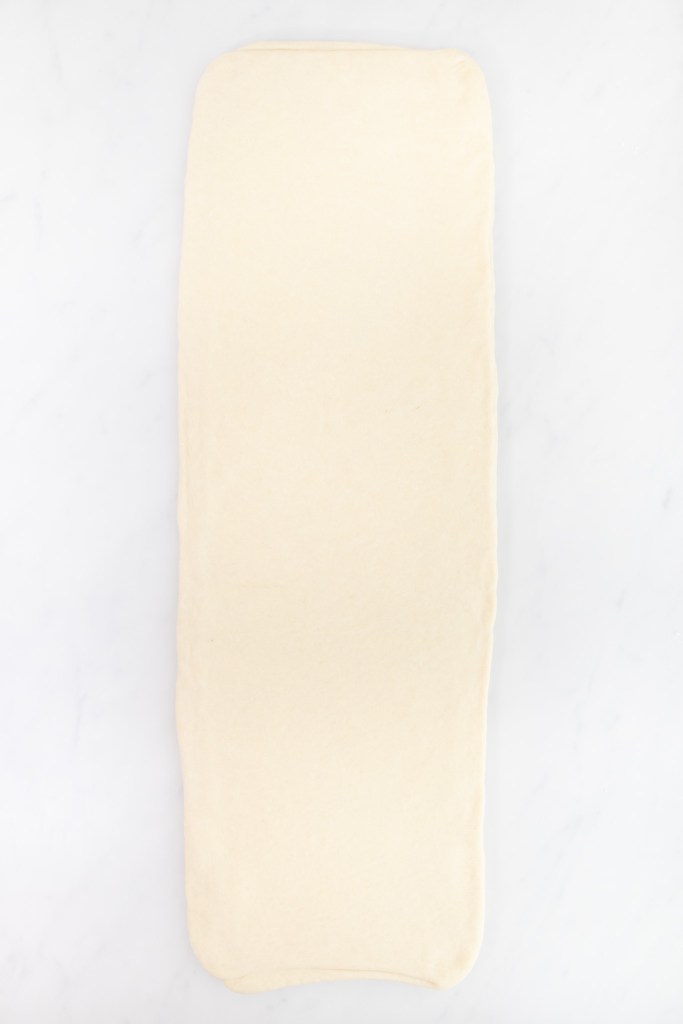
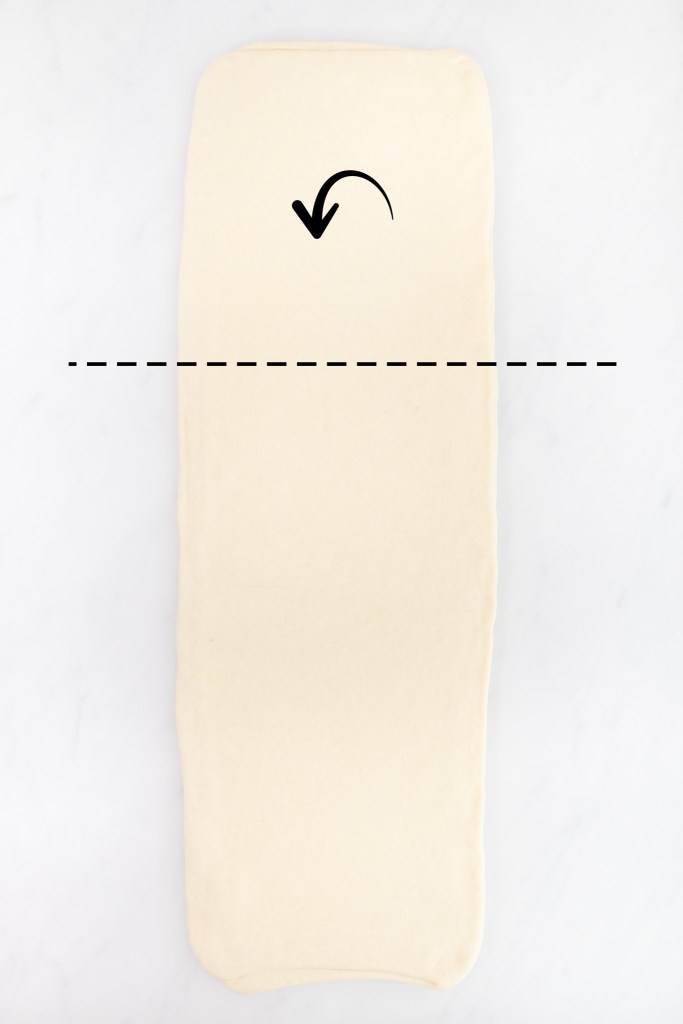
Fold the dough in thirds lengthwise (like a business letter), wrap it in plastic wrap, then chill it in the fridge overnight.


— DAY TWO —
FORMING THE CROISSANTS
Remove the dough from the fridge and allow it to sit at room temperature for 5 minutes.
Next, remove the plastic wrap, place it on a lightly floured surface, and pat the dough down with your hands (it will have puffed up some overnight).
Roll the dough out into a rectangle shape that is roughly 10.5” by 22”, trying to keep the sides as straight as possible.

Using a ruler and a pastry cutter, pizza cutter, or knife, trim all four edges (wasting as little dough as possible) to form a clean rectangle shape.


Next, cut the rectangle into quarters, lengthwise, to form four equally sized rectangles around 5″ by 10” inches (a little larger or smaller is OK).

Then, cut each smaller rectangle diagonally to form 8 right triangles.
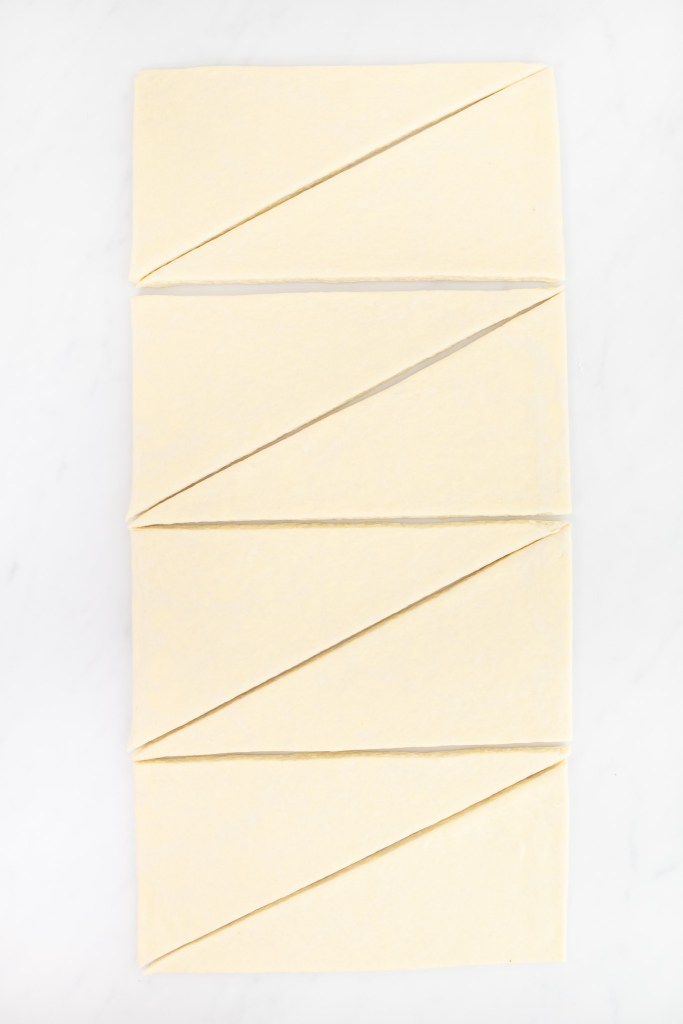
Cut a small piece off of the bottom of each right triangle to form an isosceles triangle.


Starting at the base of the triangle, pull both ends out slightly and then roll the dough up tightly towards the tip.

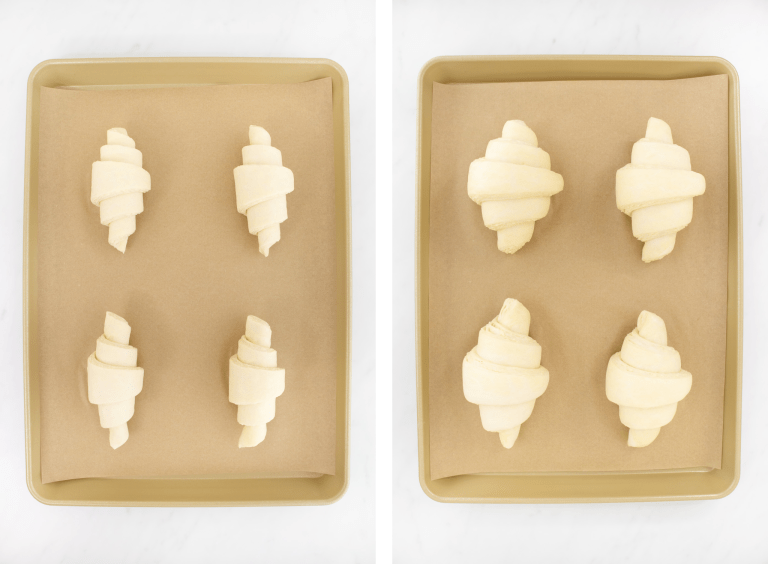
On two sheet pans lined with parchment paper, place the croissants with the tip end of the triangle on the bottom (to prevent unrolling). Cover very loosely with plastic wrap and place them in your oven (with the oven turned off!) to rise for 1 ½ to 2 hours.


BAKING THE CROISSANTS
After 2 hours, the croissants should be puffed up and jiggle slightly when the pan is shaken. Remove the pans from the oven and place them into the fridge to chill for 20 minutes.
In the meantime, preheat your oven to 375 degrees.
At this time, you can also prepare your egg wash by whisking together the egg yolk and heavy cream (or milk). Cover with plastic wrap and keep it in the fridge until ready to use.
Working quickly but carefully, remove the croissants from the fridge, discard the plastic wrap and paint the smooth top surface (and outer layer) of each croissants with the egg wash. Try not to get egg wash on the sides (exposed layers), as it may prevent them from rising correctly in the oven.
Place both pans of croissants in the oven — one in the lower ⅓ and one in the upper ⅓ — for 10 minutes. After 10 minutes, swap and rotate the pans, and bake for an additional 8 to 10 minutes, until the croissants are nice and golden brown on top.
Note: If you notice butter pooling in the pan while the croissants bake, don’t worry — this can happen, especially if it’s your first time making croissants. They will still turn out great!
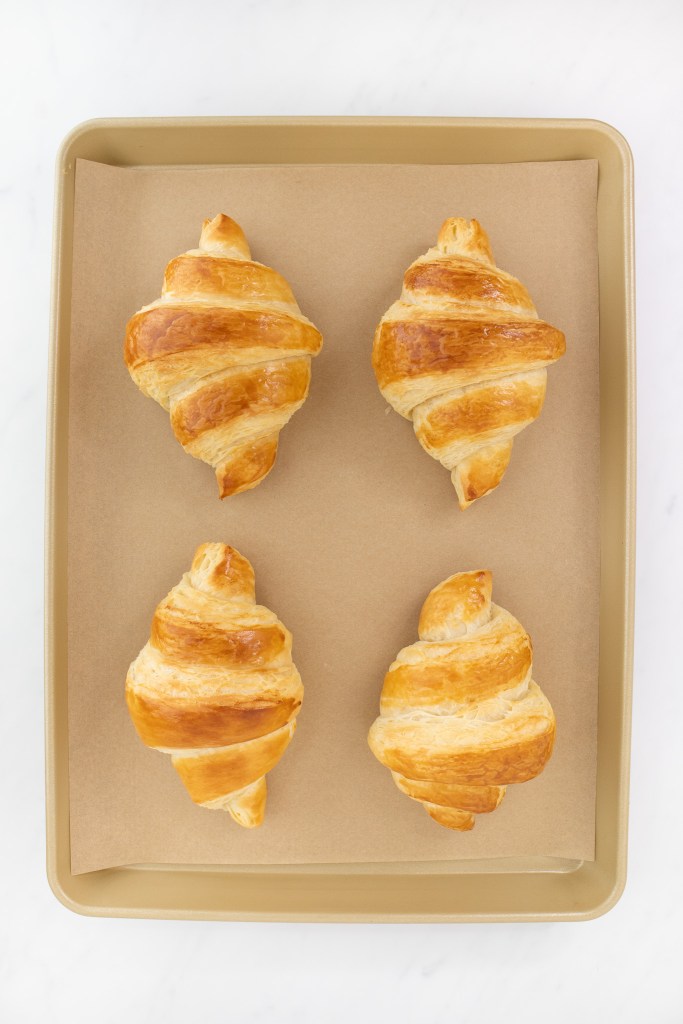
Remove the croissants from the oven and allow them to sit on the pan for 5 minutes before transferring them to a wire rack to cool completely. You can serve croissants fresh from the oven or at room temperature. Once cooled, store them in an airtight container (still at room temperature) or in an airtight freezer bag in the freezer.

Authentic French Bakery-Style Croissants

Ingredients
For Proofing the Yeast
- ½ cup water, tepid
- 1 Tbsp granulated sugar
- 2 ¼ tsp active dry yeast (1 packet)
For the Croissant Dough (Détrempe)
- Proofed yeast mixture (as prepared in this recipe)
- 4 ½ cups (563 g) unbleached all-purpose flour (sifted and leveled)
- 1 Tbsp kosher salt (I use Diamond Crystal)
- ¼ cup granulated sugar
- ½ cup water, at room temperature
- ½ cup whole milk, at room temperature
- ¼ cup (½ stick) unsalted butter, chilled and cut into ½" cubes
For the Butter Block (Beurrage)
- 1 ½ cups (3 sticks) European-style unsalted butter (see Note 2)
For the Egg Wash
- 1 egg yolk
- 1 Tbsp heavy cream, or whole milk
Equipment
- 2 Half Sheet Pans (I like these)
Instructions
— DAY ONE (8 hours) —
Proofing the Yeast
- Before beginning, check the expiry date on the packet of yeast to ensure that it has not expired.
- In a small bowl, with a fork, whisk together tepid water, sugar, and yeast. Allow to sit at room temperature until the yeast granules have all dissolved and the mixture has begun to foam (at least 5 minutes).½ cup water, tepid1 Tbsp granulated sugar2 ¼ tsp active dry yeast
Preparing the Croissant Dough (Détrempe)
- In the bowl of a stand mixer, whisk together flour, salt, and sugar. (Note: to measure the flour, I recommend either using a kitchen scale to weigh it, or sifting the flour into the measuring cup and levelling it off with the back of a knife.)4 ½ cups (563 g) unbleached all-purpose flour1 Tbsp kosher salt¼ cup granulated sugar
- Using the dough hook attachment, with the mixer on low speed, pour in water, milk, and proofed yeast mixture.½ cup water, at room temperature½ cup whole milk, at room temperatureProofed yeast mixture
- Mix on low until the dough just comes together (with no dry patches of flour remaining), scraping down the sides of the bowl as necessary. The dough will appear dry at first, but should come together after about 5 minutes.Note: At this stage, it is important for the dough to be properly hydrated. Several factors can affect hydration, such as the type/brand of flour, the exact quantity of each ingredient, and even the weather (temperature/humidity). If the dough still appears too dry, add in an additional 1 Tbsp of water (or so). If the dough is too soft or gummy in texture, sprinkle in a bit of extra flour.
- Once the dough has come together, turn the mixer off, cover the bowl with a tea towel, and allow the dough to rest for 10 minutes (the flour will continue to hydrate).
- Once the dough has rested, with the mixer on a medium-low speed, add in chilled, cubed butter. Mix until all of the butter is incorporated into the dough (about 5 to 10 minutes). (At first, it may seem like the butter will not fully incorporate, but it will — just keep mixing!) Continue to mix until the dough is smooth, stretchy, and no longer sticky to the touch.¼ cup (½ stick) unsalted butter, chilled and cut into ½" cubes
- Empty the dough onto a lightly floured surface. Knead it by hand 2 to 3 times, then form it into a smooth ball. Set the dough ball back into the mixing bowl (seam side down), cover the bowl with plastic wrap and a tea towel, and allow the dough to rise at room temperature until it has roughly doubled in volume (about 1 to 1 ½ hours).
- Using your hands, deflate the dough as you empty it back out onto a lightly floured surface. Knead the dough 2 to 3 more times, reform it into a smooth ball, and set it back into the mixing bowl. Cover the bowl (once again) with plastic wrap and a tea towel, then allow the dough to rise in the refrigerator for at least 4 hours (and up to 12 hours).
Preparing the Butter Block (Beurrage)
- Cut a piece of parchment paper to about 18" in length. In the center of the parchment paper, trace a square that is exactly 8” by 8”. Flip the parchment paper over (so the pencil markings won't come into contact with the butter), and place the 3 sticks of chilled, European-style butter side by side in the center of the square. Fold the parchment paper over the butter along the traced lines. Using a rolling pin, beat and roll out the butter until it forms a perfect 8” by 8” square of even thickness.Pro tip: European-style butter has a higher fat content than regular butter, making it more pliable (even when chilled) — ideal for lamination. If you’re struggling to shape the butter into a square, allow it to sit at room temperature for a few minutes so it's still chilled, but not fully softened. Note that the butter will warm up more quickly the thinner you roll it out.

- Chill the butter block in the refrigerator while the dough continues to rise.
Laminating the Dough (one double turn)
- Remove the dough from the fridge and set it on a lightly floured surface. Using your hands, pat the dough down and shape it into a rough square.
- Using a rolling pin, roll out the dough into a square that is at least 10” by 10”, ensuring the edges remain as straight and even as possible. The easiest way to do this is by rolling in an “X” motion, starting from the centre of the dough and rolling out towards each corner.
- Place two pieces of plastic wrap perpendicular to each other and use them to wrap the dough into a rough square. Continue rolling the dough into the corners formed by the plastic wrap, similar to how you formed the butter block (this will help in rolling out the dough into a larger square later).
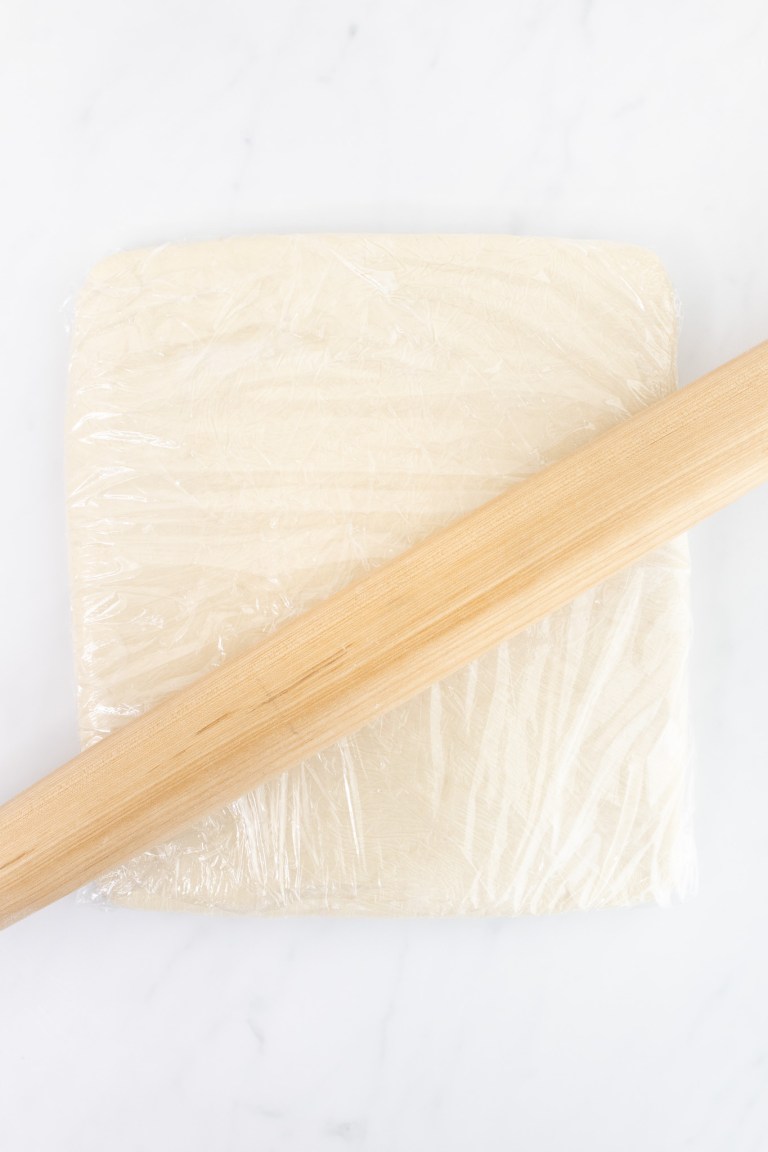
- Place the dough on a cutting board or sheet pan and set it in the freezer for 20 minutes. After 10 minutes, remove your butter block from the fridge and set aside.Note: The goal here is for the dough and butter to be as similar in texture and consistency as possible. Chilling the dough in the freezer helps it firm up slightly to match the firmness of the butter. Likewise, allowing the butter to warm slightly helps it match the softness of the dough. However, keep in mind that the butter must remain chilled, so be sure to work quickly yet carefully.
- After the dough has chilled, remove it from the freezer and unwrap it. Place the dough back on a lightly floured surface and roll it out into a square that is slightly larger than 12” by 12”.
- Unwrap the butter block and place it in the center of the dough, rotated 45 degrees to form a diamond shape. Fold the edges of the dough up and over the butter block, taking extra time and care to stretch and pinch the seams together, ensuring the butter is fully enveloped and won’t leak out when the dough is rolled.

- Roll out the the dough into a rectangle approximately 12” by 18”, again ensuring the edges remain as straight and even as possible. Be sure to lift the dough frequently to prevent it from sticking to the counter.Pro tip: If your dough begins to resist and contract, you can wait a few minutes before continuing to roll it out, but be careful not to wait too long or the butter may get too warm. Alternatively, if the dough becomes too warm, place it on a sheet pan and chill it in the refrigerator for a few minutes before proceeding.
- Using a pastry cutter, pizza cutter, or sharp knife, trim off any rounded edges from both short ends of the rectangle.

- Fold both short ends up to the centreline of the dough and pinch together the middle seam. Then, fold the dough in half along the middle seam (like closing a book towards you).

- Wrap the dough in plastic wrap and chill it in the refrigerator to rest for 1 hour.
Laminating the Dough Again (one single turn)
- Remove the dough from the fridge and set it on a lightly floured surface. Pat the dough down with your hands and gently pop any air bubbles that may have formed.
- Position the dough in front of you vertically (up and down), then roll it out into a long rectangle approximately 8” by 24”. (Note: If the dough begins to resist, allow it to rest for a few minutes as described above.)
- Fold the dough in thirds lengthwise (like a business letter), wrap it in plastic wrap, and return it to the fridge to chill overnight.
— DAY TWO (3 hours) —
Forming the Croissants
- Remove the dough from the fridge and allow it to sit at room temperature for 5 minutes.
- Unwrap the dough and set it on a lightly floured surface. Using your hands, pat down the dough, as it will have puffed up a bit overnight.
- Roll out the dough into a rectangle approximately 10.5” by 22”, again ensuring the edges remain as straight and even as possible.
- Using a pastry cutter, pizza cutter, or sharp knife, along with a straight edge (like a ruler), trim all four edges to form a clean rectangle, wasting as little dough as possible.
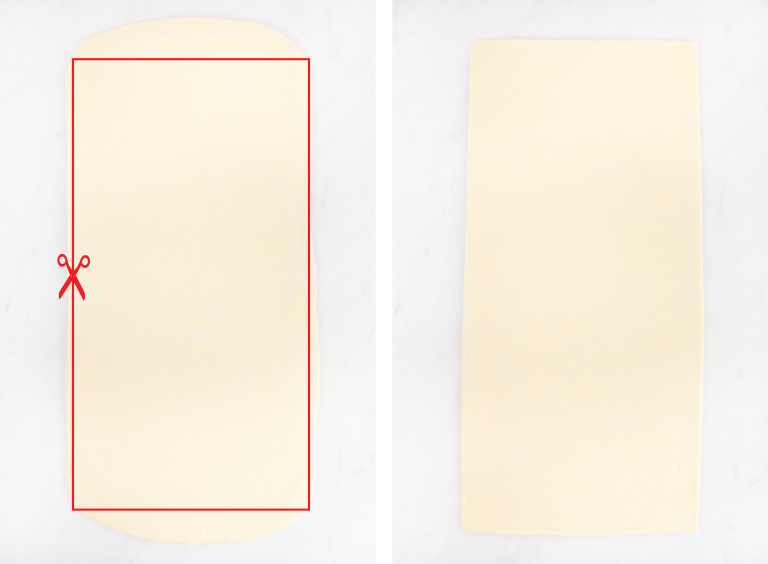
- Cut the rectangle of dough into quarters, lengthwise, forming four equally sized rectangles approximately 5" by 10" (they can be slightly smaller or larger). Cut each smaller rectangle diagonally to form 8 right triangles.

- Cut a small piece off the shorter edge of each right triangle to form 8 isosceles triangles (this will help in rolling the croissants into the proper shape.)

- Starting at the base of the triangle, pull both corners out slightly and then roll the dough tightly towards the tip.
- Place the croissants on two sheet pans lined with parchment paper, resting on their tip ends to prevent unrolling. Cover very loosely with plastic wrap and set them in the oven (with the oven turned off!) to rise for 1 ½ to 2 hours.
Baking the Croissants
- After 2 hours, the croissants should be puffed up and jiggle slightly when the pan is shaken. Remove the pans from the oven and set them in the fridge to chill for 20 minutes.
- In the meantime, preheat your oven to 375℉. In a small bowl, prepare the egg wash by whisking together the egg yolk and heavy cream (or milk). Cover with plastic wrap and refrigerate until ready to use.1 egg yolk1 Tbsp heavy cream, or whole milk
- Working quickly but carefully, remove the croissants from the refrigerator and discard the plastic wrap. Using a pastry brush, paint the smooth top surface (and outer layer) of each croissant with the prepared egg wash, being careful not to get any on the sides (or exposed layers), as it may prevent them from rising properly in the oven.
- Set both sheet pans of croissants in the oven, one in the lower ⅓ and one in the upper ⅓. Bake for 10 minutes. After 10 minutes, swap the pans (top to bottom) and rotate them 180° for even baking, then continue baking until the croissants are golden brown on top (about 8 to 10 minutes more).Note: If you notice butter pooling in the pan while the croissants bake, don’t worry — this can happen, especially if it’s your first time making croissants. They will still turn out great!
- Remove the croissants from the oven and allow them to sit on the pan for 5 minutes before transferring them to a wire rack to cool completely. You can serve croissants fresh from the oven or at room temperature. Once cooled, store them in an airtight container (at room temperature) or in an airtight freezer bag (in the freezer), depending on when you plan to serve them.
Notes
- Overview of Steps:
- Day 1: Preparing the Croissant Dough (8 hours total)
- Preparing the dough (détrempe): 30 minutes
- First rise & preparing butter block (beurrage): 1 – 1 ½ hours
- Second rise: 4 hours (or overnight)
- Laminating the dough (one double turn): 1 ½ hours
- Laminating the dough (one single turn): 30 minutes
- Overnight rest
- Day 2: Shaping & Baking The Croissants (3 hours total)
- Cutting & shaping the croissants: 30 minutes
- Final rise: 2 hours
- Egg wash & baking: 25 minutes
- Day 1: Preparing the Croissant Dough (8 hours total)
- Using European-Style Butter: You can find European-style unsalted butter at most grocery stores. While it may be slightly more expensive, its higher fat content (typically 82% to 85%) makes it more pliable than regular butter, helping it spread evenly without cracking during lamination.
- Freezing Croissant Dough: You can freeze croissant dough at any stage before the final proofing (Step 32). Simply wrap the dough (or unrisen croissants) tightly in plastic wrap, place in an airtight freezer bag, and store in the freezer for up to three months. When you’re ready to continue, thaw the dough or croissants in the fridge overnight before resuming where you left off.
- Storing/Freezing Baked Croissants: To keep croissants fresh, freeze any leftovers in an airtight freezer bag as soon as possible (preferably the same day). They’ll stay good for up to three months. When you’re ready to enjoy them, thaw on the counter or reheat in the oven for a few minutes.